My 8-year-old son was
standing on a chair
at the stove,
cooking dinner for
another man’s children,
with duct tape wrapped
around his injured forearm.
The moment he saw me,
he froze and whispered,
“Please don’t be mad, Dad.
Dwight says if dinner’s late,
I sleep in the shed.”
I stared at my terrified little boy,
and suddenly,
I knew something was
terribly wrong in my own home.
PART 1
Twenty-eight days on. Twenty-eight days off.
That’s the life of an offshore rig worker.
It pays well. It paid for our house outside Lafayette, Louisiana. It paid for my wife’s SUV and my son’s speech therapy and the swing set I built in the backyard with my own hands.
My son, Finn, is eight.
He’s small for his age and shy with strangers, but with me he never stops talking. Every night I’m offshore, we FaceTime at seven. He tells me about school, about his lizard, about the fort he’s building under the porch.
For the last month, the calls kept getting shorter.
“He’s tired,” my wife, Brandi, would say, holding the phone. “He’s already in bed.”
At 7 p.m.?
“Kids grow, Wade. He’s fine. Stop worrying.”
Then a hurricane warning shut down the platform. They flew us out by helicopter two weeks early.
I didn’t call ahead.
I wanted to surprise my boy.
I pulled into the driveway at 9:58 p.m. There was a pickup truck I didn’t recognize parked in my spot. Lifted. Mud on the tires.
The front door was unlocked.
The TV was blaring a football game. Two boys I’d never seen before, maybe ten and twelve, were sprawled on my couch eating chips.
A grown man was asleep in my recliner. Boots on. Beer in his hand.
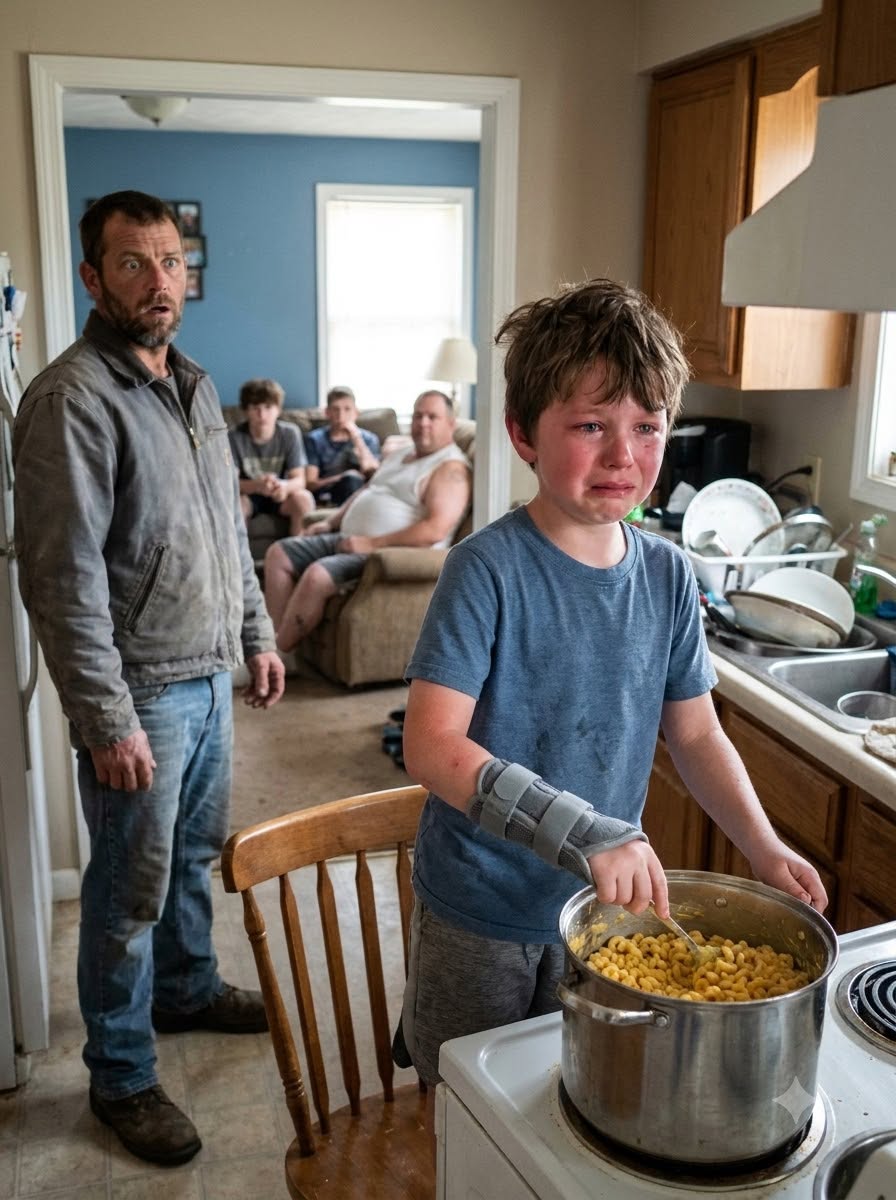
And in the kitchen, standing on a chair so he could reach the stove, was my son.
He was stirring a pot of boxed macaroni. His school uniform was stained. His hair hadn’t been cut in weeks.
His left forearm was wrapped in silver duct tape from wrist to elbow.
“Finn.”
He spun around so fast he almost fell off the chair.
For one second his face lit up.
Then it filled with fear.
“Dad, you’re not supposed to be home.”
I lifted him off the chair and held him. He was so light. Lighter than when I left.
“What happened to your arm, buddy?”
He looked over my shoulder at the man in the recliner.
“I got burned,” he whispered. “It’s okay. I put tape on it.”
“Who burned you?”
He didn’t answer.
He just said, very fast, “Don’t be mad, Dad. Dwight says if dinner’s late, I sleep in the shed.”
The shed.
The one with no windows and no light that I’d built to keep the lawnmower out of the rain.
The man in the recliner woke up.
He looked at me, then at Finn in my arms, and stood up slowly. Big guy. Neck tattoo. No shirt.
“You must be Wade,” he said. “I’m Dwight. Brandi’s friend.”
“Where’s my wife?”
“Casino in Coushatta. Girls’ night.” He smirked. “Somebody’s gotta watch the kids while she relaxes. Your boy needs discipline, man. Little guy’s soft. Cries at everything.”
His kids laughed from the couch.
“Cries like a baby,” the older one said. “Dad made him sleep in the shed Tuesday.”
Dwight shrugged.
“Builds character. My old man did worse to me.”
I set Finn down behind me.
Every part of me wanted to put Dwight through the wall.
But Finn was shaking. And I’d learned on the rig that the loudest man is rarely the one in control.
“Okay,” I said quietly. “Thanks for watching him.”
Dwight grinned. He thought I was weak.
Brandi came home at 1 a.m. smelling like cigarettes and perfume. She saw me at the kitchen table and froze.
“Wade. You’re early.”
“Who is Dwight?”
She lifted her chin.
“Someone who’s actually here. You’re gone half the year. You don’t get to come home and judge me.”
Then she looked at Finn’s arm and rolled her eyes.
“He grabbed the pan handle. He’s clumsy. Your son’s always been clumsy.”
The next morning, while Brandi slept, I went into my old office closet looking for a bandage.
I found my old phone instead. The one I’d left behind when I got a new one for work. No SIM card. It couldn’t call or text anyone.
It was still charged.
On the screen was one note in the Notes app. Titled: FOR DAD.
Twenty-six entries. All written to me. None of them ever sent. Because that phone couldn’t send anything.
The first one said:
Day 1. Hi Dad. I’m writing you every night like you said. I’m ok.
I scrolled to the last one. Written two nights before I came home.
I read it standing in that closet.
And my hands started to shake.
PART 2
Day 26. Dad, Dwight pressed my arm on the stove because the noodles burned. A man taped a paper to our door. Mom cried. Dwight said the bank is taking our house and it’s your fault for not sending enough money. Mom said I can’t tell you, because then you’ll find out where the money went. Please come home. I’m not ok.
I read it four times.
Then I slid down onto the closet floor and cried for the first time since my father’s funeral.
He had been writing to me every night. To a phone that couldn’t send a single word.
Twenty-six nights of telling me the truth, while on the other end of every FaceTime call I was being told, “He’s fine, he’s already asleep.”
I scrolled back through the drafts.
Day 9. Dwight’s boys took my lizard. They said it ran away.
Day 14. I slept in the shed. It was dark. I counted to 1,000.
Day 19. Mom said if I tell you anything, you’ll stop sending money and we’ll lose the house.
Day 22. I miss you. I put your hoodie on my pillow.
I took a screenshot of every one.
Then I went looking for the paper from the door.
It was folded inside Brandi’s purse on the kitchen counter: a notice of default from our mortgage company. Four months behind.
Four months. I had sent the mortgage money every single month.
Underneath it was a stack of casino markers from Coushatta. Thirty-one thousand dollars.
And a cashier’s check made out to Dwight Pruitt. Eight thousand dollars. Memo: “truck payment.”
My home was being gambled away one girls’ night at a time, and the man snoring in my recliner was being paid out of my son’s mortgage.
I called the Lafayette Parish Sheriff’s Office from the driveway.
Then I called my mother-in-law, Gloria, in Tulsa.
She broke down on the phone.
“She asked me for money twice this summer,” she said. “She told me you’d been laid off. Wade, I had no idea.”
Two deputies pulled up at 9 a.m.
Dwight was passed out in my recliner again. He woke up with a flashlight in his face.
“What is this?” he slurred. “Wade, man, come on.”
One deputy took a single look at Finn’s arm and gently peeled back the duct tape.
Underneath was a second-degree burn. Blistered. Infected around the edges. Shaped exactly like the rim of a pan.
The deputy’s jaw tightened.
“Who did this, son?”
Finn looked up at me.
I knelt beside him.
“You can tell the truth now, buddy. I’m home. I’m not going anywhere.”
He pointed at Dwight.
They arrested Dwight in my living room, in front of his own kids.
Brandi came downstairs in her robe, already screaming.
“You’re ruining my life! You’re never here! You don’t get to—”
The other deputy held up her purse, the default notice and the casino markers sticking out of the top.
“Ma’am, you’re going to want to stop talking and call a lawyer.”
Dwight was charged with felony child abuse.
Brandi was charged with child neglect and failure to report. The court granted me emergency custody that same afternoon. My lawyer and I brought the mortgage current in nine days. The house stayed ours.
Gloria drove down from Tulsa the next day with a new lizard for Finn in a shoebox with holes poked in the lid.
She testified on my side, too.
I quit the rig.
I took a job at a refinery twenty minutes from home. Day shift. Home by five.
The pay is less. My boy is worth more.
Finn’s arm healed with a scar shaped like a crescent moon. He says it looks cool. He tells people a shark bit him.
The first night it was just the two of us in the house, he climbed into my bed with his new lizard and my old phone.
“Can I still write to you?” he asked.
“You don’t have to anymore, buddy. I’m right here.”
He thought about it.
“I want to,” he said. “So you never miss a day again.”
So now, every night before bed, Finn types a message on that old phone. I read them in the morning over cereal.
Last night’s said:
Day 61. Dad made pancakes. Lizard is named Rig. I’m ok. For real this time.
PART 3
Nobody tells you what comes after the arrest.
I thought the hard part was over when the deputies walked Dwight out of my living room. It wasn’t. It was only the part that looked like a movie.
The real part started the next morning, in a pediatric burn clinic in Lafayette, where a nurse named Ms. Odom cleaned my son’s arm while he stared at the ceiling and counted out loud.
“Four hundred twelve. Four hundred thirteen.”
“Buddy, you can stop counting,” I told him.
“I’m not scared,” he said. “I just like numbers when it hurts.”
I had to step into the hallway.
The doctor told me the burn would scar but the infection was caught in time. Another week under that duct tape, she said, and we’d have been having a different conversation. She was kind about it. She was also required to write everything down, and she did, in a chart that would later go into a courtroom.
Two days after that, Finn did his interview at the Children’s Advocacy Center. I wasn’t allowed in the room. I sat on a couch under a painting of a cartoon whale, holding a paper cup of coffee I never drank, while a woman named Ms. Vance talked with my son behind a closed door for fifty minutes.
When it was over, she came out and sat beside me.
“He’s very brave,” she said. “And he’s very worried about you.”
“About me?”
“He asked if you were mad at him. Three times.”
I looked at the whale until my eyes stopped burning.
“I’m not mad at him,” I said. “I’m mad at me.”
She didn’t tell me I shouldn’t be. She just said, “Then let’s make sure he hears the first part more than the second.”
I went home and called the speech therapist who had worked with Finn for two years. I’d stopped the sessions in the spring because Brandi said he didn’t need them anymore. She’d said it so smoothly that I’d believed her, because believing her was easier than driving home from a rig in the middle of the Gulf.
Her name was Ms. Tran. She cried when I told her what had happened. Then she said, “Bring him Thursday. Don’t worry about the bill.”
“I can pay it,” I said.
“I know. Bring him anyway.”
The criminal case moved slowly. The prosecutor, a tired, careful woman named Ms. Delacroix, warned me early.
“People want a clean story,” she said. “Defense attorneys love to muddy it. Everything we have is going to be examined, including the notes on your old phone.”
“The notes are real.”
“I believe you. But a judge needs more than my belief.”
So we did it the right way. A forensic examiner at the Sheriff’s Office imaged the phone. He pulled the metadata on all twenty-six entries and confirmed each had been created and edited on the nights written, in the order written, in the same account, on a device with no SIM and no way to send anything. He also noted something I hadn’t seen.
“The last entry has three edits,” he said. “He started it, stopped, came back, and rewrote it. Looks like he deleted a few lines.”
“Can you recover what he deleted?”
He shook his head. “Not from this. Sorry.”
I sat in the parking lot afterward and thought about what an eight-year-old had decided not to tell me, even in a message he knew I’d never get.
Dwight’s lawyer came at us hard. He tried to say Finn was coached. He tried to say the burn was an accident. He tried to say Brandi was the real problem and Dwight was “just a houseguest.”
That last argument was the one that sank him, because it was the one Brandi’s lawyer couldn’t live with. Within a week, the two defendants stopped pretending to be on the same side.
Brandi’s lawyer called mine.
“My client wants to cooperate,” he said.
“With what?” my lawyer asked.
“With everything.”
I didn’t sit across from Brandi until the custody hearing.
She’d lost weight. Her hair was pulled back, no makeup, a cheap gray blazer someone had probably told her to wear. She looked younger and older at the same time. She looked at me once when I came in, and then she looked at the table.
The judge, a gray-haired woman with reading glasses on a chain, went through the file slowly. The deputy’s report. The burn clinic’s records. The phone. The mortgage notice. The casino markers. The cashier’s check.