Brought Down Corporate Espionage,
Redefined Integrity in Modern Aviation Operations,
and Proved That Unwavering Dignity and Justice Will Always Outweigh Arrogance and Hidden Greed
Part 1: The Girl Standing Beside 2A
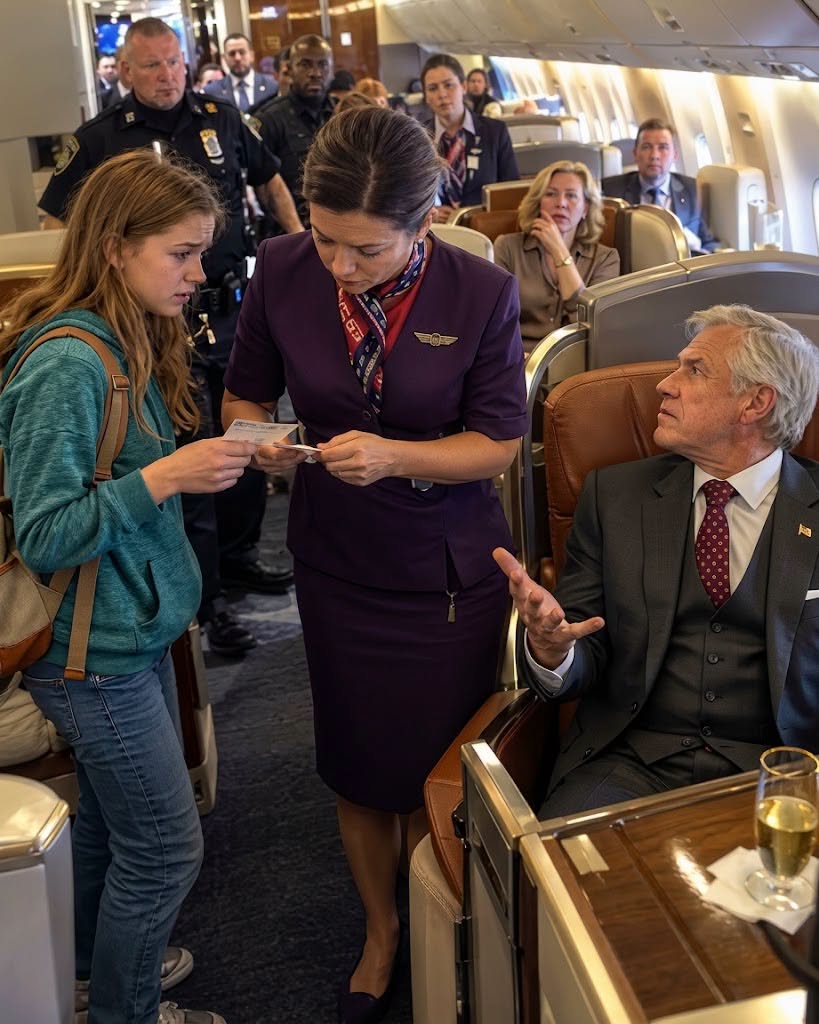
Zara held up her boarding pass and said, “Sir, you’re sitting in my seat.”
Senior flight attendant Elizabeth Hart stepped closer and took
the ticket from her hand. One number was printed beside Zara Coleman’s name: 2A.
Elizabeth looked at the surname again.
Something was wrong.
“Economy starts about thirty rows back,” Richard Bennett said without lowering his newspaper.
For a second, Zara Coleman wondered whether she had misunderstood him.
She was fourteen years old. She had traveled alone before.
She knew airports, boarding groups, passport checks,
security lines, and the particular way adults sometimes spoke more loudly to teenagers when they assumed confusion was the only explanation for disagreement.
But there was nothing confusing about the boarding pass in Zara’s hand:
NEW YORK — LONDON
FLIGHT 212
SEAT 2A
She looked above the window: 2A.
Then at the man sitting beneath it: Silver hair, dark tailored suit, polished shoes, a folded newspaper spread across his lap. His jacket had already been removed and carefully tucked beside him as though he had lived in that seat for an hour rather than several minutes.
“My ticket says that’s my seat,” Zara said.
Richard finally lowered the newspaper enough to see her. His gaze moved from her face to the charcoal sweater she wore, then to her dark trousers, black sneakers, and burgundy travel bag.
“Then somebody made a mistake.” “Could I see your boarding pass?”
That seemed to surprise him. Richard’s eyebrows lifted.
“You’re asking to see my boarding pass?” “I’m asking because mine says 2A.” “I heard you.” “Then please check yours.”
Several passengers nearby had begun paying attention. A man across the aisle stopped fastening his seat belt. A woman in Row 3 glanced over the top of her tablet.
Zara hated that part. She didn’t like becoming the center of a room. Her father had taught her something about situations like this: Never raise your voice simply because someone else wants you to lose control. People remembered the loudest person. Evidence remembered the truth.
Zara kept her voice even. “You may have 2B,” she said. “Could you please check your pass?”
Richard stared at her for another moment. Then he gave a small, humorless laugh. “You don’t belong in First Class.”
Heat rose behind Zara’s ears. She could feel it spreading down her neck. Not because she doubted herself, but because she understood exactly what he meant.
She was young.
She wasn’t dressed like the executives around him.
She had no designer coat hanging from her arm.
No assistant.
No visible parent.
No reason, in Richard Bennett’s mind, to occupy the seat he wanted.
“I have a First-Class ticket,” Zara said. “I heard you.” “Then please move.”
Instead, Richard folded his newspaper. He looked almost offended now. “Do you know who I am?”
Zara paused. “No.”
The passenger across the aisle coughed into his fist. Richard’s mouth tightened.
“Richard Bennett. Bennett Strategic Holdings.” He said it with the confidence of someone accustomed to watching recognition alter people’s posture.
Nothing altered Zara’s. “That doesn’t change the seat assignment.”
Richard blinked.
Then a voice came from behind Zara. “Is there a problem?”
Zara turned. Senior flight attendant Elizabeth Hart had approached from the forward galley. Elizabeth was in her late thirties, poised, blonde hair secured neatly behind her head, her wine-red neck scarf sitting perfectly against a crisp white blouse.
She recognized Zara. Not personally, but enough to remember her. The girl had flown this route several times over the previous year. Always polite. Always alone. Never demanding. Elizabeth remembered bringing her hot chocolate once after turbulence and finding her calmly working through a book of engineering puzzles. She did not, however, know anything about Zara’s family.
Richard answered first. “This child is confused.”
Zara did not argue. She simply held out her boarding pass. Elizabeth took it. Her eyes moved over the details.
“Seat 2A,” she said. “Exactly,” Zara replied.
Elizabeth turned to Richard. “May I see your boarding pass, sir?”
Richard exhaled theatrically. “This is ridiculous.” “Your boarding pass, please.”
He pulled it from the inside pocket of his jacket. Elizabeth compared the two. Her expression remained professional.
“Mr. Bennett, you are assigned to 2B.”
Richard pointed at the aisle seat beside him. “We’re sitting together either way.” “Yes, sir.” “So what difference does it make?” “It matters because 2A is Miss Coleman’s assigned seat.”
Richard leaned back. “I paid full fare.”
Elizabeth looked down at Zara’s pass. “So did Miss Coleman.”
Something changed in Elizabeth’s expression. Not much. Just a pause.
COLEMAN.
Her gaze lingered on the surname. It meant something. Or almost meant something. She looked at Zara. Zara noticed. Richard did not.
“I need you to move to Seat 2B, sir,” Elizabeth said. “No.”
The answer came instantly. A quiet ripple moved through the passengers listening nearby.
Elizabeth remained still. “Mr. Bennett, the seating assignment is not optional.” “I’m already settled.” “The aircraft has not departed.” “And I’m not rearranging myself because some kid suddenly wants the window.” “It isn’t sudden,” Zara said. “It’s printed on my boarding pass.”
Richard ignored her. He looked at Elizabeth instead. “Was she upgraded?”
Elizabeth’s expression cooled. “Excuse me?” “Was she upgraded at the gate? Is somebody doing her a favor?”
A man in Row 3 muttered, “Come on.” Richard heard him but didn’t turn.
Elizabeth’s tone sharpened. “Miss Coleman holds a valid First-Class ticket for Seat 2A.”
Richard glanced at Zara again. “You don’t belong here.”
This time the words landed differently. Zara stopped trying to convince him. She looked at the seat number. At Elizabeth. Then at Richard.
“Keep it.”
Elizabeth frowned. “Miss Coleman, you don’t have to do that.” “I know.”
Richard smiled. It was small. Satisfied. “Good choice.”
Zara met his eyes. “You may feel differently in a few seconds.”
The smile weakened. “What is that supposed to mean?”
Zara turned away. She walked toward the forward galley. Elizabeth followed.
“Miss Coleman?”
Zara reached into her bag and took out her phone. Her father had programmed a small folder into it before her first solo international trip. Not because he feared flying, but because he understood operations, emergencies, systems, and how quickly ordinary problems became dangerous when adults stopped listening to one another.
The folder was protected. There were only three contacts:
Brought Down Corporate Espionage, Redefined Integrity in Modern Aviation Operations, and Proved That Unwavering Dignity and Justice Will Always Outweigh Arrogance and Hidden Greed
HOME
SECURITY
DAD — OPERATIONS
Zara tapped the last one.
Behind her, Elizabeth looked once more at the boarding pass. COLEMAN. Her eyes narrowed, then widened.
“Wait,” she whispered.
The call connected after one ring.
“Z?” Her father’s voice changed instantly when he heard her breathing. “Dad.” “What happened?”
Zara looked down the aisle. Richard had reopened his newspaper. He was sitting in 2A as though he had won.
“A passenger took my assigned seat.” “Which seat?” “2A.” “Did the crew verify your pass?” “Yes.” “Did they verify his?” “Yes. He has 2B.”
A pause. “Why isn’t he moving?”
Zara lowered her voice. “He said I don’t belong in First Class.”
Silence. Not an angry silence. Something colder.
“Is the crew involved?” “Yes. Elizabeth tried.”
Beside Zara, Elizabeth stopped breathing for a second. Her eyes moved toward the cockpit.
“Did anyone touch you?” Marcus asked. “No.” “Are you safe?” “Yes.” “Flight number?” “Two-twelve.” “Route?” “New York to London.”
Another pause. Zara knew what her father was doing. He was not asking questions because he had forgotten her itinerary—he was verifying facts.
“Dad,” she said quietly. “They took my seat.” “I understand.”
Elizabeth stared at Zara, then at the phone. A memory seemed to arrive all at once.
Coleman. Marcus Coleman.
She had seen the name—not on passenger lists, but in company briefings, operational memos, and emergency authorization chains.
Zara drew one slow breath. “Shut it down.”
There was no drama in her voice. No anger.
Across the cabin, Richard turned another page.
Then something changed near the aircraft door. Elizabeth’s colleague, Noah, had been checking a catering seal. His handheld device chimed. He stopped.
The gate agent outside the aircraft looked down at her tablet. Her posture stiffened. She lifted one hand toward the jet bridge operator.
“Hold the door.”
Richard slowly looked up from his newspaper.
The gate agent received another message. Then she turned toward someone approaching through the jet bridge—someone wearing a dark airport security jacket.
And walking beside him was a man carrying a red operations folder marked:
FLIGHT 212 — IMMEDIATE HOLD.
The man with the red operations folder stopped at the aircraft door and looked directly at Elizabeth.
“Who is Miss Coleman?” he asked.
Elizabeth raised her hand slowly.
“She is right here.”
Zara stepped forward, still holding her phone, while every conversation in First Class seemed to disappear at once.
The man opened the folder and showed Elizabeth a document on the first page.
“Flight 212 is under an immediate operational hold,” he said. “No passenger is to be moved, removed, or boarded until this matter is resolved.”
Richard lowered his newspaper completely.
“What matter?” Richard demanded.
The operations officer looked at him without expression.
“That depends on why you are occupying Seat 2A.”
Richard’s face changed slightly, but he recovered quickly.
“There has been a seating error.”
“There has not,” Elizabeth said quietly.
She held up both boarding passes.
“Miss Coleman is assigned to 2A. Mr. Bennett is assigned to 2B.”
The officer nodded once.
“Then we have a different problem.”
Richard stood up.
“I don’t appreciate being treated like a criminal.”
The officer did not react.
“Neither do we, Mr. Bennett.”
He turned to Zara.
“Miss Coleman, your father asked that you remain with the crew and not discuss operational details with anyone.”
Zara nodded.
“I understand.”
Richard stared at her.
“Your father?” he asked.
Zara said nothing.
That silence seemed to bother him more than any answer could have.
The gate agent suddenly stepped inside and whispered something to Elizabeth.
Elizabeth’s eyes widened.
“They’ve frozen Mr. Bennett’s boarding record.”
Richard heard her and immediately reached for his phone.
“No,” he said. “You can’t do that.”
The operations officer closed the red folder.
“Actually, sir, we already did.”
Then he looked toward the cockpit door as another message appeared on his device.
Zara’s phone vibrated in her hand.
One sentence from her father appeared on the screen:
Brought Down Corporate Espionage, Redefined Integrity in Modern Aviation Operations, and Proved That Unwavering Dignity and Justice Will Always Outweigh Arrogance and Hidden Greed
STAY CALM. I’M COMING.
Zara looked up toward the jet bridge, and for the first time, Richard Bennett looked genuinely nervous.
The man in the red folder stepped aside.
Footsteps echoed from the terminal.
Elizabeth recognized the person approaching before anyone else did.
Richard turned toward the door, and the color slowly drained from his face.
Marcus Coleman entered the aircraft without saying a word.
He looked at Zara first, making sure she was safe.
Then his eyes moved to Seat 2A, where Richard had been standing.
“Mr. Bennett,” he said calmly, “we need to talk about why you thought my daughter had no right to sit there.”
Marcus Coleman stood at the aircraft door, calm enough to make the silence feel heavier.
Zara looked at her father and gave him a small nod, silently telling him she was all right.
Marcus then turned toward Richard Bennett, who was still standing beside 2A.
“My daughter didn’t ask for special treatment,” he said. “She simply expected the seat she paid for.”
Richard straightened his jacket and tried to recover his confidence.
“Mr. Coleman, I had no idea she was your daughter.”
Marcus looked at him for several seconds.
“That’s exactly the problem.”
Richard frowned.
“What is that supposed to mean?”
Marcus answered quietly, “You shouldn’t need to know who her father is before you decide to treat her with respect.”
Elizabeth lowered her eyes for a moment.
She finally understood why Zara’s surname had seemed familiar. Marcus Coleman wasn’t simply an executive with influence; he was connected to several of the airline’s largest operational contracts.
But none of that explained the red folder.
Marcus hadn’t come because his daughter was embarrassed.
Something much larger had been triggered.
The operations officer opened the folder again.
“Mr. Bennett, your reservation was changed at 6:42 this morning.”
Richard’s expression froze.
“Changed by whom?” he asked.
“That’s what we’re trying to determine.”
The officer showed him the record, and Richard immediately shook his head.
“I didn’t authorize that.”
Marcus glanced at the document.
“Neither did my daughter.”
Zara stepped closer.
“Dad, what happened?”
Marcus looked at her gently.
“Someone attempted to move you from 2A before you even boarded.”
Zara’s eyes widened.
“But why?”
Marcus didn’t answer immediately.
He looked toward the gate agent instead.
The gate agent handed him a second document.
“Sir, there is something else.”
Marcus read it silently, and his expression became serious.
The document showed that Zara’s seat had been flagged for reassignment under an internal priority code. That code was normally reserved for senior corporate travelers and government officials.
Richard looked at the paper and suddenly stopped arguing.
“I’ve never seen that code before,” Elizabeth said.
Marcus nodded.
“Most people haven’t.”
Richard’s voice became quieter.
“Are you accusing me of changing her reservation?”
Marcus looked directly at him.
“No, Mr. Bennett. I’m giving you the opportunity to tell us who asked you to sit in her seat.”
Richard opened his mouth, but nothing came out.
The operations officer received another alert and checked his screen.
“We have an answer,” he said.
Everyone turned toward him.
“The request came from inside the airline’s own system.”
Elizabeth stared at the screen in disbelief.
Zara instinctively reached for her father’s hand.
Marcus squeezed it once.
“You did the right thing,” he whispered.
Then he turned back toward the operations officer.
“Find out who entered the request.”
The officer nodded and began making a call.
A few seconds later, the aircraft intercom made a soft chime.
The captain’s voice came through, asking everyone to remain seated.
Richard slowly lowered himself into 2B.
For the first time since Zara had walked onto the aircraft, he looked less like an important businessman and more like a man who had just realized he might have been used.
Then the operations officer’s phone rang.
He answered, listened for five seconds, and looked directly at Marcus.
“Sir,” he said carefully, “we found the person who authorized the change.”
Marcus’s expression hardened.
“Who?”
The officer glanced toward the cockpit, then back at Zara.
“It wasn’t Mr. Bennett,” he said. “And it wasn’t anyone at the gate.”
He paused.
“The authorization came from someone with access to your daughter’s passenger profile.”
Zara’s face went pale.
Marcus immediately pulled her closer.
“Then we find out why,” he said.
The jet bridge door remained firmly secured behind the operations team.
Outside, the night tarmac glistened under drizzle.
Inside the forward galley, the tension sat so heavy that nobody dared shift their weight.
Marcus Coleman kept his arm wrapped around his daughter’s shoulder. His face remained calm, yet his eyes held a steely focus that commanded absolute obedience.
He looked directly at the operations supervisor.
“Identify the terminal and the credentials used,” Marcus demanded softly.
His voice did not carry anger, only an irrefutable authority. He had built safety protocols across three continents; rogue access was intolerable.
The officer, whose badge identified him as Vance Campbell, held the tablet closer.
The blue glow highlighted the tight lines of his jaw.
He scrolled down through three encrypted audit logs.
“The override originated inside our corporate terminal at Heathrow,” Vance said. “It bypassed standard ground ticketing entirely. The login was entered via an executive credential registered under Fleet Logistics.”
Elizabeth Hart touched the collar of her scarf.
Her breath caught in her throat.
She had worked transatlantic routes for twelve years, and Fleet Logistics never touched passenger manifests without high-level clearance.
“Fleet Logistics only manages aircraft assignments,” Elizabeth noted quietly. “They handle heavy routing, fuel allocation, and maintenance rotations. They have no operational reason to alter passenger seat reservations.”
“Precisely,” Marcus agreed. “Unless someone was monitoring my daughter’s movements from within the company.”
He looked down at Zara, whose brown eyes remained focused and remarkably clear despite the commotion.
“Dad, who has access to my profile?” Zara asked.
Her tone was steady. She remembered her father’s rule about maintaining poise when an unknown variable entered a familiar system.
“Only three people in the London office hold family override rights,” Marcus answered. “My deputy director, the regional security head, and the vice president of corporate acquisitions, Julian Croft.”
At the mention of Croft, Richard Bennett’s eyes shifted.
He was sitting in 2B with his hands pressed together. The arrogance that had once fueled his refusal had completely evaporated.
Marcus noticed the subtle reaction immediately.
He stepped past the bulkhead and stood beside Row 2.
“Mr. Bennett, you recognized that name. Tell us why you chose this exact flight.”
Richard swallowed hard, his throat clicking in the silence.
“Julian invited me to London for an informal summit. We were scheduled to finalize an equity partnership regarding Bennett Strategic Holdings.”
“An equity partnership,” Marcus repeated evenly. “Which required you to leave New York tonight, on this exact airframe, seated directly in front of the forward communication console.”
“I didn’t choose the seat,” Richard stammered, pulling at his collar. “My assistant received an automated confirmation directly from Croft’s office. It said Seat 2A was cleared and secured.”
“Did your assistant verify that confirmation?” Marcus asked. “Or did you simply assume the universe owed you whatever seat had your coat draped across its leather armrest?”
Richard lowered his head. For a man who ran multi-million-dollar hedge portfolios, he suddenly looked small and deflated.
“I assumed it was a VIP courtesy. I didn’t question it.”
“You didn’t question it because entitlement rarely inspects its own credentials,” Marcus said without malice. “You saw a teenager, assumed she was inferior, and demanded she move thirty rows back.”
The passengers in Rows 3 and 4 were listening intently. The executive across the aisle who had coughed earlier looked away, embarrassed on behalf of the class he shared with Richard.
Vance tapped Marcus’s elbow.
“Mr. Coleman, the system log shows a secondary data packet. A local device in this cabin synced with the seat sensor in 2A ten minutes ago.”
Zara pulled her phone from her pocket. She opened the airline’s companion application.
“Dad, look at the baggage tracking page. My bag status hasn’t moved past the ramp scan.”
Marcus glanced at the screen, then looked back at Vance.
“They didn’t just want her seat. They wanted her luggage separated, and they wanted someone placed beside that overhead locker.”
Elizabeth took a step toward locker 2A.
“Miss Coleman placed her burgundy bag in the forward compartment right above that row. I saw her slide it in before Mr. Bennett arrived.”
“Don’t open it,” Vance ordered smoothly.
He signaled the armed security officer standing at the cabin door.
“We need an inspection of the compartment housing before anyone departs.”
The passengers in First Class grew restless, but nobody complained. The atmosphere had transitioned from a petulant seating dispute into a high-level operational lockdown, conducted with clinical precision.
Marcus took his daughter’s hand.
“Zara, sit in 1A for now. Elizabeth, please keep the forward curtain drawn. We are keeping this area isolated until Port Authority security finishes.”
Zara did as she was told. She slid into 1A, placed her notebook on the tray table, and watched the reflection of the cabin in the dark oval window.
Captain Miller emerged from the flight deck. He adjusted his cap, looking at Marcus with immediate respect.
“Marcus, operations briefed me over the company radio. What are our orders?”
“We aren’t pushing back until Vance sweeps the locker and Julian Croft’s terminal access is revoked across every regional server,” Marcus stated without hesitation. “Safety takes absolute priority.”
“Understood,” Miller replied. “We have an open slot for another twenty-five minutes. After that, we lose our oceanic track and have to refile the entire transatlantic plan.”
“Then we refile,” Marcus said firmly. “I will not have this aircraft over the North Atlantic with an unverified credential floating through its internal passenger service directory.”
Richard looked up from 2B, his voice trembling slightly.
“Mr. Coleman, I swear on my life, I had no knowledge of any luggage or security breaches. I just wanted my seat.”
“I believe you were a pawn, Mr. Bennett,” Marcus replied coolly. “Arrogant men make wonderful shields for clever conspirators. Your vanity made you the perfect distraction in this aisle.”
Richard sank back against the headrest. The sting of those words was far worse than any civil lawsuit. He realized his reputation had just been shattered by his own pride.
Vance brought out a small electronic scanner. He reached up toward the overhead bin above 2A, running the wand along the latch and the interior hinges of the ceiling panel.
The scanner gave two brief, muted beeps.
Vance’s brow furrowed. He shone a narrow flashlight along the rubber seam of the cabin inspection panel behind the life-vest cradle.
“There is an active transmitter here,” Vance said softly. “It isn’t commercial airline equipment. It’s an auxiliary beacon wired directly into the seat’s maintenance power tap.”
Elizabeth gasps quietly, covering her mouth.
“Someone accessed that compartment during the turnaround in New York? The maintenance crew had thirty minutes between arrival and boarding.”
“It takes three minutes if you have an authorized badge,” Marcus observed, his expression turning to stone. “Someone planned this knowing Zara flew this flight every month to visit her academy.”
Zara leaned forward from 1A.
“Dad, that beacon… was it tracking my bag, or was it listening to the forward communication circuit behind the bulkhead wall?”
Marcus looked at his daughter with quiet admiration. Her analytical mind had spotted the true target instantly. The burgundy bag was a decoy; the seat itself was the intercept.
“The forward communication line handles executive corporate calls during flight,” Marcus explained. “Julian knew I was routing our quarterly merger documents through the secure cockpit relay tonight.”
“He wanted the data,” Richard whispered, suddenly understanding the full picture. “Bennett Strategic was bidding on that same transport infrastructure contract against Coleman Logistics.”
“And you thought you were meeting him in London for lunch,” Marcus said, looking down at Richard. “He lured you onto this flight to take the seat directly over the receiver.”
Had Richard remained seated quietly, the receiver would have operated uninterrupted, shielded by a prominent passenger whose presence in First Class would draw zero suspicion from the crew.
The only flaw in Croft’s entire design was Zara Coleman.
Croft had calculated that an unaccompanied teenager would meekly retreat to the back of the aircraft when confronted by wealth.
Croft had counted on intimidation. He had relied on the casual cruelty of people who believe boarding passes are suggestions when weighed against age, status, and tailored suits.
Instead, Zara had refused to yell.
She had refused to submit.
She had stood her ground with polite clarity, and then she had pulled the operational emergency cord.
Vance used a non-conductive tool to detach the transmitter from the wiring harness. He sealed it inside an electrostatic evidence pouch and noted the serial number in his red folder.
“Port Authority police are detaining the maintenance supervisor on the ground here in New York,” Vance announced after checking his radio. “He confessed to receiving a ten-thousand-dollar transfer.”
“From whom?” Elizabeth asked, leaning against the galley counter.
She was visibly relieved that the danger was being dismantled methodically right before her eyes.
Brought Down Corporate Espionage, Redefined Integrity in Modern Aviation Operations, and Proved That Unwavering Dignity and Justice Will Always Outweigh Arrogance and Hidden Greed
“From an offshore entity registered to Croft’s brother,” Vance answered. “The paper trail is already unraveling across the international financial crime registry.”
Marcus turned to the gate agent who was still waiting at the door.
“Release the boarding hold on the main cabin. Let the passengers know we depart in twenty minutes.”
The gate agent nodded swiftly and retreated down the jet bridge. The tense, frozen atmosphere in the airplane began to thaw as normal operational rhythms slowly returned.
Captain Miller tipped his hat to Marcus.
“We will make up the time over Newfoundland. The winds are in our favor tonight, Mr. Coleman. Zara will arrive right on schedule.”
“Thank you, Captain,” Marcus replied warmly. “Ensure my daughter gets a hot meal, and let the cockpit door remain locked according to standard protocol.”
Marcus then walked over to Row 1 and knelt beside Zara. He brushed a stray strand of hair from her forehead.
“You handled that with tremendous grace, Z.”
“You always said that panic is just an emotional surcharge on a problem that requires logic,” Zara replied, a small smile finally gracing her lips.
“I did say that,” Marcus smiled proudly. “And you proved it tonight. You kept your head when an entire cabin expected you to break or back down.”
Marcus stood up and turned his attention back to Richard Bennett, who was still frozen in 2B, his newspaper discarded on the floor by his expensive shoes.
“As for you, Mr. Bennett,” Marcus said, his voice dropping into a register of utter finality. “You will not be flying with this carrier tonight, or on any partner airline.”
Richard looked up, pale and desperate.
“Please, Mr. Coleman. Think of the market impact. If Bennett Strategic is banned from international transport partners, our stock will collapse.”
“You should have considered your market impact before you told a child she didn’t belong in a seat she earned,” Marcus said smoothly. “Actions have structural consequences.”
Vance motioned to the airport security officers waiting outside.
“Mr. Bennett, gather your belongings. Your boarding privileges have been formally revoked under federal non-compliance regulations.”
Richard didn’t argue. He knew that any resistance would result in physical handcuffs.
He picked up his coat, folded his newspaper, and walked down the aisle with his head down.
The passengers watched him walk out. The woman in Row 3 who had watched over her tablet gave Zara a warm nod of respect as Richard disappeared down the jet bridge.
Elizabeth smiled, adjusting her scarf one last time.
“Miss Coleman, your assigned seat is now entirely clean, inspected, and ready for you whenever you wish to take it.”
Zara stood up from 1A, picked up her small burgundy bag, and slid gracefully into Seat 2A. She fastened her seat belt, feeling the cool leather under her fingers.
“Thank you, Elizabeth,” Zara said softly. “I appreciate you checking the boarding pass when nobody else wanted to question the situation.”
“It’s my job, Miss Coleman,” Elizabeth replied warmly. “And it was an honor to watch someone remind this cabin that rules apply to everyone equally.”
Marcus leaned down through the open window row to kiss his daughter’s cheek.
“Call me the moment you land at Heathrow. Your aunt is meeting you at baggage claim.”
“I will, Dad,” Zara promised. “Go back home. Get some sleep. I know you have to deal with Croft’s board meeting in the morning.”
“Croft won’t be at that meeting,” Marcus said with a grim chuckle. “His flight from corporate leadership will be considerably less comfortable than yours.”
With a final wave, Marcus Coleman exited the aircraft, the jet bridge pulled away, and the heavy cabin door closed with a reassuring hydraulic hiss.
Flight 212 pushed back from the terminal beneath the New York rain, its engines spooling up with a deep, confident roar that vibrated through the floorboards.
Zara looked out through the double-paned window of 2A. The airport lights blurred into streaks of gold and ruby across the wet runway as the jet accelerated.
She pulled her engineering puzzle book from her seat pocket, clicked her pen, and began working through the first diagram, entirely at peace above the rising clouds.
Ten hours later, London greeted the transatlantic flight with a pale autumn dawn that broke through silver clouds, casting golden light across the runways of Heathrow.
Zara Coleman walked off the aircraft with her burgundy bag slung over her shoulder. She thanked Captain Miller and Elizabeth Hart at the forward door with genuine warmth.
Waiting at the arrivals gate was not just her aunt, but three senior airline representatives who bowed their heads respectfully as she walked into the terminal corridor.
The afternoon papers across London and New York were already running the headlines: Julian Croft had been arrested at his country estate, his illegal surveillance ring dismantled entirely.
Bennett Strategic Holdings had released an emergency statement announcing Richard Bennett’s immediate resignation, citing a failure of personal character and leadership ethics.
Far away from the boardrooms and corporate scandals, Zara sat in a quiet tea shop overlooking Hyde Park, stirring a cup of hot chocolate with her family.
She didn’t need a newspaper to know who she was.
She had learned long ago that true authority never relies on titles, suits, or demanding the window seat.
It lives in quiet truth, unwavering dignity, and the simple courage to stand firm when the world tries to tell you that you don’t belong where you stand.
Brought Down Corporate Espionage, Redefined Integrity in Modern Aviation Operations, and Proved That Unwavering Dignity and Justice Will Always Outweigh Arrogance and Hidden Greed
The Corporate Fallout and the Shadow Board
The pale autumn sunlight filtering through the tall windows of the Hyde Park tea shop gave Zara’s hot chocolate a amber glow. Beside her, her aunt Catherine sat nursing a cup of Earl Grey, her sharp eyes scanning the digital edition of The Financial Times on her tablet. Across the table, Marcus Coleman sat back in his wingback chair, looking remarkably rested considering he had spent the last fourteen hours coordinating a multi-jurisdictional corporate takedown from a secure terminal at JFK.
“The markets opened twenty minutes ago in London,” Catherine noted, tapping the screen. “Croft’s primary hedge fund is down forty-two percent. Trading has been suspended on three separate exchanges.”
“It’s not just the stock,” Marcus said quietly, taking a sip of black coffee. “The federal prosecutor in Manhattan unsealed the indictments an hour ago. Croft wasn’t just attempting to manipulate the airline’s executive board. He was using a network of shell companies in the Cayman Islands and Liechtenstein to siphon capital from the union pension funds. He thought he could leverage Richard Bennett’s political influence to push through a deregulated buyout before anyone audited the books.”
Zara set her cup down, her mind naturally tracing the logical connections as if analyzing a complex engineering schematic. “That’s why Richard was so desperate to establish control on the flight,” she realized. “He wasn’t just being arrogant in Seat 2B. He knew the board meeting this morning was his last chance to execute the proxy vote before the auditors flagged the discrepancies. He needed to prove to Croft that he still held absolute authority over the partner logistics.”
“Exactly,” Marcus confirmed, a proud glimmer in his eye. “Richard believed that by making a display of power—by publicly humbling anyone who represented the Coleman family estate—he could signal to the remaining institutional investors that the merger was inevitable. He assumed a fourteen-year-old girl traveling alone in First Class was an easy target for a public demonstration of dominance.”
“He calculated the wrong variables,” Zara said simply.
“He certainly did,” Catherine chuckled, setting her tablet down. “The video recorded by the passenger in Row 3—the woman with the tablet—has already amassed over fourteen million views. It shows Richard demanding your removal, followed by the gate agent’s official notice of his federal non-compliance ban. Bennett Strategic Holdings tried to run damage control by claiming Richard had suffered a ‘temporary medical episode brought on by exhaustion,’ but the board didn’t buy it. They forced his resignation before the market bell even rang.”
While the news was satisfying, Marcus knew that cutting off the visible branches of a weed did not destroy its roots. Julian Croft was in custody, and Richard Bennett was financially ruined, but Croft’s shadow network inside the international aviation conglomerate was vast. For five years, Croft had quietly placed key operatives across ground operations, fleet maintenance, and regional logistics, building a parallel syndicate that skimmed millions off cargo charters and international routes.
Marcus’s phone vibrated on the marble tabletop. He looked down at the encrypted caller ID and picked it up immediately.
“Vance,” Marcus said.
“Mr. Coleman,” Vance’s steady voice came through the speaker. “We’ve secured the mainframe at Croft’s estate in Berkshire. Our forensic accountants just pulled the secondary ledger. It’s worse than we thought.”
“How much worse?”
“Croft wasn’t just stealing pension funds,” Vance reported. “He was using five of our trans-Atlantic widebody aircraft to transport unregistered, unmanifested high-value assets across international borders. He bypassed security protocols by bribing regional dispatchers and ground supervisors in Zurich, Frankfurt, and London.”
Marcus’s jaw tightened. “Which aircraft?”
Vance paused on the line. “Flight 212—the very plane Zara landed on this morning—is listed as one of the primary transport vessels. The ground crew at Heathrow is currently prepping it for a return leg to Munich. If that plane takes off, the secondary evidence Croft left hidden in the cargo hold’s avionics bay will be wiped remotely by his overseas associates.”
Marcus stood up from the table, his demeanor instantly shifting from devoted father to commander of an empire. “Tell airport security to lock down Aircraft N782NC immediately. Nobody touches that frame until my team arrives.”
“I’ve already alerted Heathrow authorities, sir,” Vance replied. “But there’s a problem. Croft’s chief logistics officer, a man named Arthur Pendelton, is currently inside the maintenance hangar. He just filed a emergency override flight plan under the pretense of a ferry positioning flight. They’re preparing to push that plane out of the hangar within fifteen minutes.”
Zara stood up beside her father. She had heard every word through the phone’s high-fidelity receiver. “Dad, Flight 212’s primary avionics bay isn’t accessible through the main cabin or standard cargo door. It’s behind the forward bulkhead in the lower deck. The only way to wipe the manual diagnostic logs remotely is if someone physically engages the backup generator switch near the nose gear.”
Marcus looked at his daughter, struck by her immediate grasp of the technical architecture. “You read the schematic on the plane.”
“I solved the system puzzle on the flight over,” Zara said calmly, pulling her burgundy bag over her shoulder. “If Pendelton is trying to wipe the logs, he doesn’t just need a software override. He needs to physically flip the manual circuit breaker inside the nose wheel well before the engines start. We have fifteen minutes to stop him.”
Without another word, Marcus, Zara, and Catherine exited the tea shop and stepped into a sleek, black security detail vehicle waiting at the curb, its blue strobe lights flashing as it accelerated into the London traffic toward Heathrow’s private maintenance sector.
Brought Down Corporate Espionage, Redefined Integrity in Modern Aviation Operations, and Proved That Unwavering Dignity and Justice Will Always Outweigh Arrogance and Hidden Greed
The Saboteur at Gate 42
The rain that had battered New York the previous evening had followed the weather front across the Atlantic, casting a grey, misty veil over Heathrow’s sprawling tarmac. Inside Hangar 4, the massive Boeing 787-9 Dreamliner—the very plane that had carried Zara safely across the ocean hours earlier—sat bathed in harsh yellow floodlights.
Air pressure tools whined in the background, but the standard maintenance crew was nowhere to be seen. Instead, three men in unmarked black coveralls stood near the open nose gear compartment, holding heavy diagnostic tablets connected by thick industrial cables to the aircraft’s belly.
Arthur Pendelton, a cold, wire-thin man in his late fifties with slicked-back hair and a sharp charcoal suit beneath an open raincoat, paced back and forth near the hydraulic lifts. He checked his watch frantically.
“How much longer?” Pendelton demanded, his voice echoing off the corrugated metal walls of the hangar.
“The primary wipe is at eighty percent,” one of the technicians replied, his fingers flying across his tablet screen. “Once the digital ledger is cleared, we just need to pull the hard drives from the forward avionics bay. But we need to cycle the manual breaker in the wheel well to cut power to the redundant flight recorder, otherwise the FAA auto-sync will upload the backup logs to the cloud the moment the engines draw power.”
“Then do it now,” Pendelton snapped. “Croft’s lawyers are trying to secure bail, but if those flight ledgers reach the Serious Fraud Office, none of us are getting out of Europe. We pull the drives, load them into the charter jet on Runway 2, and we’re in the air before Coleman’s people even realize what happened.”
“I wouldn’t be so sure about that, Pendelton,” a deep, resonant voice echoed from the main pedestrian entrance of the hangar.
Pendelton froze, spinning around.
Marcus Coleman walked through the high-arched doorway, flanked by Vance and six armed officers from the Metropolitan Police’s Aviation Security Command. Behind them, Zara stepped into the illuminated space, her eyes immediately scanning the blue and orange cables snaking into the nose wheel well.
Pendelton’s face contorted into a mask of rage and fear. “Coleman. You have no jurisdiction in this hangar. This is a private maintenance facility under contract with European Air Logistics.”
“It was under contract,” Marcus said, stepping forward with total composure. “Until two hours ago, when the board of directors voted unanimously to strip Croft Enterprises of all operational oversight. You’re standing on property owned directly by Coleman Global Transatlantic, Pendelton. And you’re attempting to destroy federal evidence.”
Pendelton backed up toward the nose gear, signaling subtly to his two technicians. “You’re too late, Marcus. The remote command was sent three minutes ago. The main servers are already purged. In sixty seconds, the avionics bay will suffer a simulated electrical short, destroying every drive inside.”
“He’s lying, Dad,” Zara’s voice rang out, clear and precise.
Everyone in the hangar turned to look at the young girl standing in her neat wool coat.
“The 787’s triple-redundant flight control architecture doesn’t allow a simulated short from an external terminal without an active ground power unit supplying 115 volts AC,” Zara explained, walking forward with unhurried confidence. She pointed to the heavy cable running from the hangar wall to the aircraft’s power receptacle. “They haven’t engaged the main power cart yet because the green indicator light on the junction box is still flashing. They’re running on auxiliary battery power.”
The lead technician looked at Zara in sheer disbelief, his mouth slightly open. “How does a kid know the bus sequence for a Dreamliner?”
“Because she understands that logic always defeats panic,” Marcus said smoothly.
Zara didn’t pause. She looked directly at the technician holding the main tablet. “And because you connected your diagnostic harness to the secondary maintenance bus instead of the primary master line, your purge command is currently stuck in an unbuffered command loop. You didn’t wipe the ledger. You just locked yourself out of the system.”
“Check the screen!” Pendelton screamed at the technician.
The technician frantically tapped his screen, his face draining of color as a bright red error message illuminated his features: [SYSTEM LOCKOUT: ACCESS DENIED – LOCAL OVERRIDE REQUIRED].
“She’s right,” the technician stammered, stepping back from the control panel. “The secondary bus blocked the purge. The encrypted logs are completely intact.”
Pendelton lunged forward, reaching for the manual circuit breaker handle inside the dark recess of the nose gear compartment. “I’ll drop the system manually!”
Before he could pull the heavy steel handle, Vance sprinted forward with incredible speed, grabbing Pendelton’s wrist and slamming him against the thick titanium strut of the nose gear. The heavy metal handle snapped back into its locked position with a loud, metallic clank.
Within seconds, the Metropolitan Police officers moved in, slapping heavy steel handcuffs onto Pendelton and his two technicians.
Pendelton struggled against the restraints, glaring at Marcus and then down at Zara. “You think this changes anything, Coleman? Croft built a system that runs deeper than a few airplane manifests. You can’t stop what’s already in motion!”
“The system you built was based on fear, secrecy, and arrogance,” Marcus replied, looking down at the disgraced executive with calm disdain. “And like every system built on bad architecture, it collapses the moment it meets structural integrity.”
Marcus turned to the senior police inspector. “Take them away. Make sure the forensic team recovers those tablets intact.”
As the officers led Pendelton and his syndicate out into the rain, the massive hangar fell quiet once more. The floodlights reflected off the polished white belly of Flight 212.
Zara walked over to the nose gear, reaching out to gently touch the smooth, cold metal of the aircraft hull.
“Is the plane okay?” she asked softly.
Marcus walked up beside her, placing a warm hand on her shoulder. “The plane is perfect, Z. Thanks to you, every record, every flight path, and every truth it carried is safe.”
Brought Down Corporate Espionage, Redefined Integrity in Modern Aviation Operations, and Proved That Unwavering Dignity and Justice Will Always Outweigh Arrogance and Hidden Greed
The Emergency Assembly
Three days later, the glass-and-steel skyscraper housing the international headquarters of the Transatlantic Aviation Alliance overlooked the skyline of Manhattan. Inside the grand auditorium on the top floor, over two hundred board members, institutional investors, airline executives, and federal regulators were seated in quiet, anxious anticipation.
The corporate scandal sparked by Julian Croft’s arrest and Richard Bennett’s public fall had sent shockwaves through the global financial markets. Rumors of insolvency, systemic corruption, and compromised flight safety had caused the alliance’s stock to plummet. The press was calling it the greatest governance failure in civil aviation history.
At the front of the auditorium sat an elevated dais. At the center sat Marcus Coleman, flanked by the newly appointed interim board of directors. Sitting quietly in the front row of the audience, wearing a simple navy blazer and her hair tied back neatly, was Zara.
The murmurs in the room hushed as Marcus stood up and walked to the podium. Behind him, a massive screen displayed the real-time financial and operational status of the entire transatlantic fleet.
“Ladies and gentlemen,” Marcus began, his voice projecting through the room with effortless authority. “Over the past seventy-two hours, this alliance has faced an existential test. Men who were trusted to lead this organization chose instead to use its power for personal enrichment, political coercion, and illegal operations.”
A tense silence hung over the room. Several senior executives who had been allied with Croft shifted uncomfortably in their leather seats.
“Julian Croft and Richard Bennett believed that an organization of this scale belonged to those who could bully, deceive, and manipulate their way into control,” Marcus continued. “They viewed our passengers, our flight crews, and our ground personnel as mere variables to be exploited on a balance sheet. They believed that rules were written for the weak, and that privilege conferred immunity.”
Marcus paused, his gaze sweeping across the rows of powerful men and women.
“They were wrong,” Marcus declared firmly. “An airline does not run on corporate arrogance or backroom deals. It runs on precision, accountability, and absolute trust. When a passenger boards an aircraft, whether they sit in Row 1 or Row 35, they entrust us with their lives. That trust is built on a contract—a promise that every wire has been inspected, every rule has been followed, and every individual is treated with equal dignity under the law.”
Marcus tapped a control key on the podium. The main screen behind him shifted, displaying a comprehensive, transparent restructuring plan that outlined the immediate removal of all compromised executives, the restoration of the union pension funds, and the implementation of open-source forensic tracking for all international cargo manifests.
“Effective immediately,” Marcus announced, “Coleman Global Transatlantic has completed a full buyout of Croft Enterprises’ remaining shares. We are returning forty percent of the voting equity to the operational workers—the pilots, the flight attendants, the mechanics, and the gate agents who keep our planes in the air every single day.”
The room erupted into applause. In the third row, Elizabeth Hart, the chief purser from Flight 212 who had been invited to attend the assembly as a guest of honor, wiped a small tear from her eye and applauded proudly.
“Furthermore,” Marcus continued, looking toward the front row, “we are establishing the Transatlantic Integrity Foundation—a non-profit organization dedicated to advancing technical education and ethical leadership for young engineers across the world. And I can think of no one better qualified to serve as the founding youth chair than the person who reminded an entire cabin—and an entire corporate board—that true strength never backs down in the face of unlawful authority.”
Marcus extended his hand toward his daughter. “Zara, please join me.”
The auditorium burst into resounding applause as Zara stood up from her seat. She walked up the side steps of the stage with grace and composure, her footfalls steady on the polished hardwood. She stood beside her father at the podium, looking out at the sea of industry leaders, journalists, and officers.
Marcus stepped back slightly, allowing Zara to address the microphone.
Zara looked out at the vast room. She didn’t feel nervous. To her, the room was just another complex system, and truth was its foundational code.
“When I was six years old,” Zara spoke into the microphone, her calm voice carrying across the silent hall, “my father taught me an important lesson about engineering. He said that if a bridge is designed with an error in its math, it doesn’t matter how expensive the steel is, or how famous the architect is. Eventually, under real pressure, the bridge will collapse.”
She paused, making eye contact with several veteran executives in the front row.
“Integrity is the math of human character,” Zara continued smoothly. “You can buy expensive suits, you can demand the best seats, and you can try to talk over people who speak softly. But if your character lacks integrity, you are structurally flawed. And when the pressure comes, you will fail. This alliance was built by people who believed in hard work, technical mastery, and fairness. Moving forward, that is the only architecture we will accept.”
The auditorium stood up as one, offering a thunderous standing ovation that echoed through the top floors of the skyscraper. Journalists snapped photographs, board members nodded in profound respect, and Elizabeth Hart smiled broadly from her seat.
Zara looked at her father, who smiled down at her with unconditional pride. She knew the corporate battle was over. The bad actors had been removed, the truth had been vindicated,
Brought Down Corporate Espionage, Redefined Integrity in Modern Aviation Operations, and Proved That Unwavering Dignity and Justice Will Always Outweigh Arrogance and Hidden Greed
The Sky Above the Clouds
Six months later, the early summer evening over the North Atlantic was clear and brilliant. A soft purple gradient brushed the horizon as Flight 212 coasted smoothly at thirty-eight thousand feet, its twin engines humming a soft, rhythmic lullaby.
Inside the First Class cabin, the soft blue ambient lighting created a serene, tranquil environment. The smell of fresh espresso and warm pastries lingered in the air.
In Seat 2A—the window seat she had earned, claimed, and defended—sat Zara Coleman.
She had grown an inch taller over the spring, her face bearing a subtle maturity that reflected the extraordinary events of the past year. On her tray table rested an advanced structural engineering textbook alongside a high-powered tablet running complex fluid dynamics simulations.
A gentle chime sounded through the cabin, and the door to the forward galley opened.
Elizabeth Hart stepped into the aisle holding a small tray with a cup of hot chocolate topped with extra whipped cream and a small plate of shortbread cookies. She walked down Row 1 and stopped at Row 2, smiling warmly.
“Good evening, Miss Coleman,” Elizabeth said softly, setting the tray down on Zara’s side console. “Captain Miller asked me to let you know that we’ve just crossed the coast of Ireland. We expect a smooth descent into Heathrow in forty-five minutes.”
Zara looked up from her tablet, her face lighting up with a genuine, warm smile. “Thank you, Elizabeth. How is the new flight crew settling in?”
“It’s a completely different airline, Zara,” Elizabeth answered, her eyes shining with quiet gratitude. “The morale across the entire fleet has never been higher. The new equity structure means every crew member feels like they actually own a piece of the sky they fly through. And the ground crew at JFK told me to give you their personal regards.”
“Tell them I said hello,” Zara replied. “And please thank Captain Miller for the smooth flight. The stability on this route has been perfect.”
“I will,” Elizabeth smiled, adjusting her crisp uniform jacket. “Enjoy your chocolate, Zara.”
As Elizabeth returned to the galley, Zara took a sip of the warm, rich chocolate and turned her gaze back to the double-paned window of Seat 2A.
Below the aircraft, a vast blanket of silver clouds stretched out to the edge of the world, illuminated from beneath by the fading golden light of the setting sun. The wingtip light flashed rhythmically against the darkening sky—a steady, unyielding beacon cutting through the cold expanse of high altitude.
Zara placed her hands gently on the leather armrests of her seat.
She remembered the night Richard Bennett had stood over her, his voice booming with toxic entitlement, demanding that she surrender her space because he believed his title gave him ownership of the world. She remembered the cold stares of the indifferent onlookers, the heavy silence of a cabin that had almost allowed injustice to happen simply because it was uncomfortable to speak up.
And she remembered how her father’s voice had sliced through the noise, not with anger or violence, but with the quiet, overwhelming power of unyielding truth.
Panic is just an emotional surcharge on a problem that requires logic.
Zara opened her notebook, clicking her favorite silver pen. Across the clean white page, she began sketching out the structural schematic for a new type of low-emission wing design—a project she was presenting to the European Aeronautics Youth Summit in London the following afternoon.
She didn’t feel superior to anyone in the cabin. She didn’t feel entitled to special treatment, nor did she care about the luxury or prestige of First Class. To her, Seat 2A was simply a place where she could sit quietly, look out at the infinite expanse of the sky, and do the work she loved.
The cabin lights dimmed further as the aircraft began its gentle, calculated descent toward the glittering expanse of London below.
Zara leaned her head back against the soft leather headrest, watching the golden lights of the distant coast flicker through the clouds. She knew that life would bring more challenges, more arrogant men like Croft and Bennett, and more moments where the world would test her resolve.
But as Flight 212 sliced smoothly through the night sky, completely stable and unshakeable in its flight path, Zara Coleman smiled to herself.
She knew who she was. She knew where she stood. And no matter how loud the world shouted, she would never give up her seat again.
THE END.!