Part 1 of 5
My son struck me because I asked my daughter-in-law not to smoke indoors.
Fifteen minutes later, I picked up my phone — and changed the entire course of my life.
The sound of his hand against my cheek was sharper than any argument we’d ever had.
One moment I said, “Sloan, could you please not smoke in the kitchen? My lungs can’t handle it.”
The next, my head jerked sideways, my skin burning, the room tilting.
I’m seventy-three.
And my only child struck me — in the immaculate kitchen of a house I never imagined
he’d own when I raised him alone in a tiny Columbus apartment.
Sloan exhaled a long ribbon of smoke as if nothing had happened.
Her designer leggings, flawless makeup, and bored expression made me feel like
I was an inconvenience in my own son’s home — not the woman who once worked three jobs just to keep the lights on.
“Maybe now you’ll stop talking,” my son said.
His voice didn’t crack.
He wasn’t furious.
He sounded… inconvenienced.
Like I was the disruption.
Then he turned away from me, pressed a kiss to Sloan’s forehead, and said, “Want to go out for dinner tonight?”
She smiled, flicked her cigarette into a dish I’d washed that morning, and nodded.
Fifteen minutes later they were out the door, arm in arm, laughing as they climbed into their luxury car and drove off — leaving me alone in a silence thicker than the smoke they left behind.
The ticking clock, the hum of the refrigerator… and my breathing — tight, uneven, painful.
My doctor warned me that years of factory dust had damaged my lungs. I’d begged them not to smoke indoors. That was all.
I walked down the hallway to the “guest room.”
Not my room.
A sterile, picture-perfect space staged for company, not family. On the nightstand sat a picture of my son at his high school graduation — me with an arm around him, both of us smiling like we had the whole world ahead.
Where did that version of him go?
My cheek throbbed. Shame and fury twisted together.
For half a year, I told myself to be grateful, not difficult, not demanding.
They had the big house. I had no place else to go.
But that moment ended something.
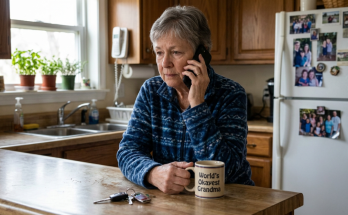
My hand trembled as I picked up my phone. I skipped over the numbers of people who only called on Christmas, old neighbors who’d moved away… and then I found the names I hadn’t dialed in years.
The young man I took in when he had nowhere to go — now a high-powered attorney.
The girl whose mother I cared for so she could finish school — now a journalist.
The college kid who ate at my table almost every night — now a financial investigator who knows how to follow a paper trail better than anyone.
Funny thing about helping people keep their heads above water: some of them grow up and never forget the hands that held them up.
I pressed the first number.
“Loretta? Are you alright?” he answered on the first ring.
I almost lied.
I almost said, “I’m fine.”
Instead, for the first time in my life, I told the truth:
“No. I’m not fine. I need help.”
Three calls later, my cheek was still swollen, but something deep in me felt rooted and steady.
I wasn’t just a burden in someone else’s home.
I was a woman with decades of receipts — in my heart and on my phone.
Later that night, the garage door rumbled. Their voices floated upstairs — light, cheerful, untouched by what had happened. I didn’t move. I lay in the dark, scrolling through photos I had quietly taken over the past six months:
The cramped “guest” space.
The broken window latch.
The tiny washroom I’d been assigned.
The money I handed over each month.
The proof of every indignity I swallowed to keep peace.
For the first time, those pictures looked less like memories… and more like evidence.
The next morning, I woke before dawn. My cheek had darkened to a deep bruise. I took one last photo. Then I slipped on the soft cardigan my son gifted me long before he stopped trying to be a good man.
I walked into the kitchen as if nothing had happened.
He scrolled his phone.
She ate her yogurt.
Neither of them looked up.
“Morning,” I said.
He muttered it back. Sloan didn’t bother.
I poured myself coffee and sat exactly where I’d stood when he struck me. My heartbeat was steady, my hands still.
At 9:00 a.m. sharp, the doorbell rang.
My son finally raised his head, confused.
“Are you expecting someone?”
I set my cup down, pushed back my chair, and stood.
“Yes,” I said. “I am.”
My son’s name is Daniel.
I suppose I should have said that sooner.
For the previous six months, I had stopped thinking of him as Daniel and started thinking of him as my son, because the second description contained memories the first could no longer carry.
Daniel at five, asleep with his cheek on my knee while I sewed a button back onto my work uniform.
Daniel at eleven, bringing home a spelling test with a red 100 at the top.
Daniel at seventeen, promising me that one day I would never have to worry about money again.
Daniel at twenty-three, standing beside me at the hospital after my sister died, holding my hand so tightly that my fingers went numb.
My son had done those things.
Daniel, the man in the kitchen, stared toward the front door.
The bell rang again.
Sloan lowered her spoon.
“Who is it?”
“Someone I invited.”
Daniel’s expression changed.
It wasn’t fear.
Not yet.
It was irritation, as if I’d scheduled a plumber without consulting him.
“Mom, this is my house.”
“I’m aware.”
“Then why are you inviting strangers?”
“They aren’t strangers.”
I walked to the door.
Daniel followed.
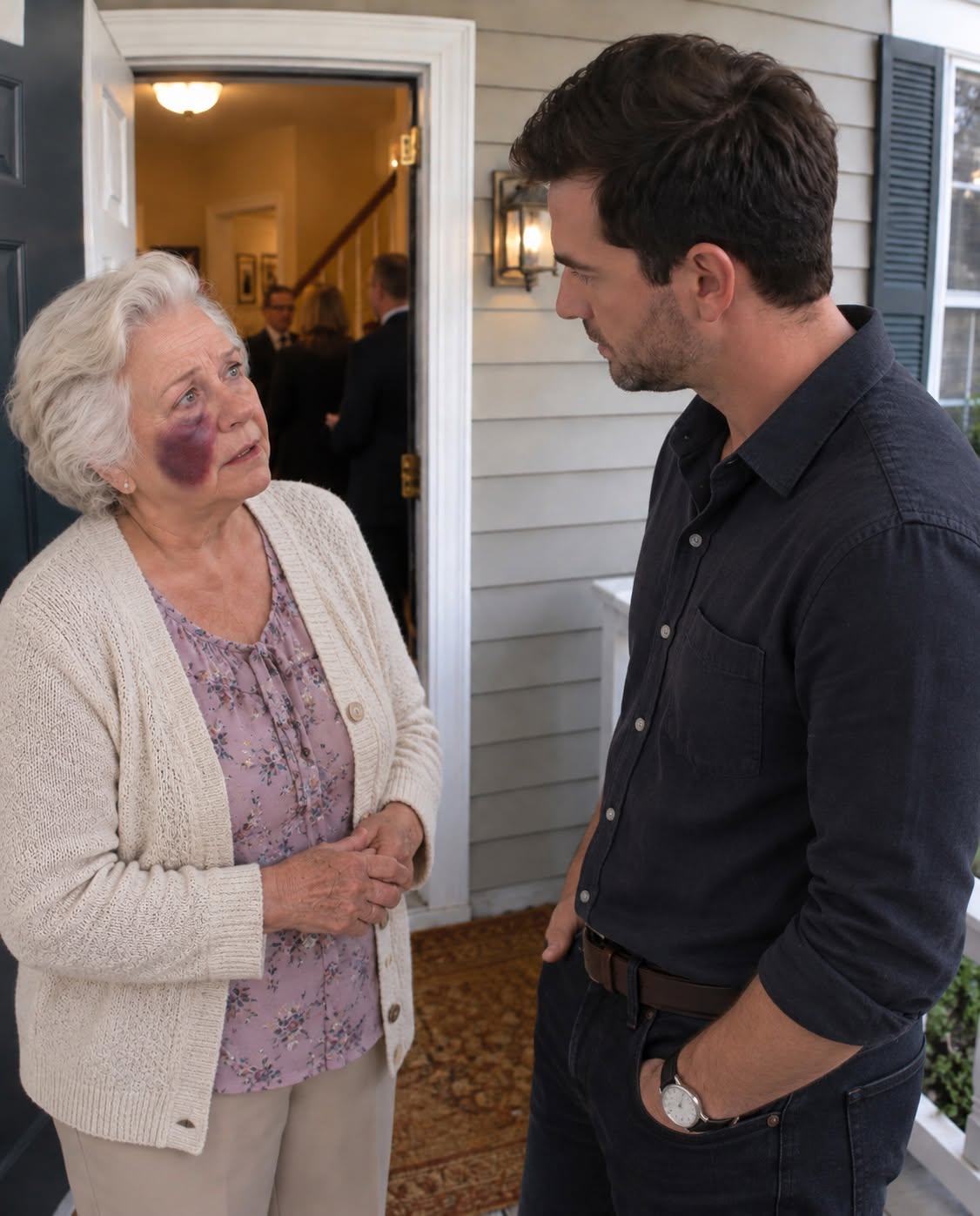
When I opened it, Aaron Bell stood on the porch.
He had been sixteen when I first met him, all elbows and anger, sleeping in the back seat of a rusted Buick because his father had thrown him out. Daniel had brought him home after school and said, “Mom, can Aaron stay for dinner?”
Dinner became three nights.
Three nights became four months.
Aaron was fifty-one now. Silver threaded his close-cut hair. He wore a charcoal coat over a dark suit and carried no briefcase, only a leather folder tucked beneath one arm.
For half a second, neither of us spoke.
Then his face softened.
“Oh, Loretta.”
He saw the bruise.
That was all it took.
His professional composure disappeared, and for one aching instant I saw the skinny boy who used to stand in my kitchen asking whether he could have another biscuit.
He stepped forward.
I let him hug me.
Behind me, Daniel said, “Aaron?”
Aaron released me slowly.
“Hello, Dan.”
They had once been nearly brothers.
That history entered the hallway with him.
Daniel looked genuinely stunned.
“What are you doing here?”
“Your mother asked me to come.”
Sloan had appeared behind him.
Her gaze moved from Aaron’s suit to me and back again.
“Is this some kind of lawyer thing?”
Aaron looked at me.
He did not answer for me.
That mattered.
All morning I had been afraid someone would arrive and take over. Tell me what to do. Speak about me while I stood nearby.
Aaron had understood without being asked.
I drew a breath.
“I’m leaving today.”
Daniel blinked.
Sloan leaned against the wall.
Then Daniel laughed once.
It wasn’t amusement. It was disbelief.
“Leaving for where?”
“I have somewhere to go.”
“No, you don’t.”
Three words.
Simple words.
Yet something inside me went very still.
He said them with confidence.
Not concern.
Not Where will you live?
Not Are you safe?
You don’t.
As though he had inventoried the boundaries of my life and knew exactly how small they were.
Aaron heard it too.
His eyes narrowed.
Daniel noticed.
“Oh, come on. Don’t make this dramatic. Mom sold her place. She lives here. I’m stating a fact.”
“I have options,” I said.
“What options?”
“That isn’t your concern.”
For the first time in perhaps twenty years, Daniel looked at me as if I had spoken in a language he didn’t understand.
Sloan crossed her arms.
“So she calls a lawyer because of one family disagreement?”
Aaron’s jaw tightened, but I lifted my hand.
“I called a friend.”
Sloan’s eyes settled on my bruise.
Something moved across her face.
Not guilt.
Calculation.
“You fell,” she said.
The room went quiet.
Even Daniel looked at her.
I touched my cheek.
“I did not.”
“You told me you felt dizzy yesterday.”
“No.”
“You did.”
“No, Sloan.”
Her lips tightened.
Then Daniel spoke.
“Everybody needs to calm down.”
Aaron’s voice was measured.
“Loretta has packed what she wants to take. I’m here to help her leave peacefully. That’s all that needs to happen right now.”
Daniel looked at me.
“You packed?”
“Yes.”
“When?”
“This morning.”
His face altered again.
This time I saw something I couldn’t immediately name.
He glanced toward the stairs.
Then toward the little desk beside the foyer.
Then back at me.
“Did you go into my office?”
“No.”
The question came too quickly.
Aaron noticed.
So did I.
“I said I packed my own things.”
“I was just asking.”
“Why?”
“No reason.”
Sloan pushed away from the wall.
“Daniel.”
One word.
A warning.
He ignored her.
“How much are you taking?”
I almost smiled at the absurdity of it.
“My clothes.”
“I mean money.”
Aaron’s expression sharpened.
I said, “My money is mine.”
“Obviously.”
But again, the answer came too fast.
My heart began to beat differently.
Not panic.
Recognition.
Six months of tiny moments suddenly shuffled themselves into a new order.
Daniel insisting he could handle my bills online because computers “confused me.”
Daniel arranging the sale of my small condominium after my fall.
Daniel telling me it made no sense to maintain my separate checking account when he could “simplify everything.”
Daniel bringing papers to the hospital rehabilitation center and pointing to places where I should sign.
I had trusted him.
Not blindly.
Worse.
Naturally.
Trusting Daniel had been as automatic as locking the front door at night.
Aaron looked at me.
I could tell he wanted to ask a question.
Not here.
Not yet.
“Your bags?” he said.
“Upstairs.”
“I’ll get them.”
Daniel stepped in front of him.
“You’re not wandering around my house.”
Aaron stopped.
They stood nearly shoulder to shoulder.
Daniel was broader.
Aaron was calmer.
I suddenly remembered them at seventeen, fighting over whose turn it was to use my old Pontiac. I had made both boys sit at the kitchen table until they could apologize without sarcasm.
Back then, Daniel always cracked first.
Sorry, Ma.
The memory hurt more than my cheek.
“Aaron stays here,” I said. “I’ll get the bags.”
I climbed the stairs myself.
Each step felt like moving through layers of a life I had mistaken for security.
At the guest room, I took my suitcase from beside the bed.
On impulse, I opened the nightstand drawer.
The graduation photograph lay where I had left it.
I picked it up.
Then I noticed the envelope beneath it.
White.
Unsealed.
My name written across the front.
LORETTA VALE.
I frowned.
I had never seen it before.
Inside were three pages of financial statements.
At first they meant nothing.
Numbers.
Dates.
Account codes.
Then I saw my name again.
Loretta M. Vale Living Trust.
My breath stopped.
I had no living trust.
At least none I remembered creating.
Beneath the heading was the name of a bank I did not use.
And beneath that:
Authorized trustee: Daniel Vale.
My hands went cold.
The account balance was more money than I had ever possessed in my life.
$418,206.73.
I sat on the edge of the bed.
That couldn’t be mine.
My condominium had sold for less than half that.
My retirement savings had never approached such a number.
I turned to the second page.
There were deposits going back fourteen months.
Transfers.
Dividend payments.
Something identified only as Harrow Settlement Distribution.
I had never heard of Harrow.
A floorboard creaked outside.
I shoved the papers back into the envelope.
The door opened.
Sloan stood there.
Neither of us spoke.
Her eyes dropped to the envelope in my hand.
For the first time since I’d moved into the house, every trace of boredom disappeared from her face.
“Where did you get that?”
I rose slowly.
“It was in my drawer.”
She came inside and closed the door behind her.
“Sloan—”
“You need to give that to me.”
“No.”
Her eyes widened.
Not because I refused.
Because, perhaps, she had never imagined I would.
“That doesn’t concern you.”
“My name is on it.”
“You don’t understand what it is.”
“Then explain it.”
She looked toward the hallway.
When she spoke again, her voice had fallen almost to a whisper.
“Daniel told me he destroyed those.”
My fingers tightened around the envelope.
“Destroyed what?”
She shook her head.
“This isn’t how this was supposed to happen.”
“What happened?”
“Loretta, please.”
It was the first time Sloan had ever said my name like that.
Not coldly.
Not dismissively.
She sounded frightened.
From downstairs, Daniel called, “Mom?”
Sloan stepped closer.
“If Aaron sees those papers, everything changes.”
“Maybe it should.”
“You don’t understand.”
“That seems to be the sentence everyone uses when they don’t want me asking questions.”
Her eyes filled.
I had never seen Sloan cry.
I didn’t know whether to believe it now.
She reached for the envelope, then stopped herself.
“Daniel didn’t tell you about your brother, did he?”
The room seemed to contract around us.
“My brother?”
Sloan stared at me.
I had one brother.
Thomas.
Thomas had been dead for thirty-one years.
“What about him?”
Downstairs, Daniel called again.
Sloan’s face had gone pale.
“That money,” she whispered, “didn’t come from your condo.”
I felt the edges of the envelope bite into my palm.
“Then where did it come from?”
She looked toward the closed door.
When she answered, her voice was barely audible.
“Thomas left it to you.”
I could hear nothing but the blood in my ears.
“That’s impossible.”
“No.”
“My brother died with nothing.”
“That’s what you were told.”
I stared at her.
“By whom?”
Sloan swallowed.
Then the bedroom door opened behind her.
Daniel stood in the hallway.
His gaze went immediately to the envelope.
And for the first time since his hand had struck my face, my son looked afraid of me.
Part 2 of 5
Daniel did not ask what Sloan had told me.
That told me she had told the truth.
He merely stood there, one hand on the doorframe, staring at the envelope.
“Sloan,” he said quietly.
She turned.
“I didn’t tell her everything.”
His eyes shut.
It was a small gesture, but it carried years inside it.
“Get downstairs.”
“No.”
“Sloan.”
“She deserves to know.”
His head snapped up.
“You don’t get to decide that now.”
“And you did?”
I watched them.
For six months I had believed their marriage ran along simple lines. Sloan wanted something, Daniel provided it. Sloan complained, Daniel defended her. They moved through the world like a polished unit.
Now, in a guest bedroom with an old woman holding an envelope, a crack opened between them.
And through it I saw fear.
Not fear of me.
Fear of a secret they had been carrying together.
I put the envelope into my handbag.
“I’m leaving.”
Daniel stepped into the doorway.
“Mom.”
“Move.”
“We need to talk.”
“We have needed to talk for months.”
“I can explain.”
“Then explain while I pack.”
Perhaps he expected anger.
I had expected anger from myself.
Instead, I felt terribly calm.
I folded my cardigan into the suitcase.
Daniel remained in the doorway.
“Uncle Thomas didn’t die broke.”
“I’ve gathered that.”
“He owned shares in a manufacturing company.”
“What company?”
“Harrow Industrial.”
The name on the statement.
I remembered it faintly then.
Not as an investment.
As a place.
Thomas had worked maintenance at a machine-parts plant outside Dayton during the 1980s. He came home every Christmas smelling faintly of machine oil no matter how carefully he scrubbed.
“Harrow closed.”
“The original plant did.”
I turned.
“And my brother owned part of it?”
“A small part initially. The company reorganized. His shares changed. There were mergers. I don’t know every detail.”
“But you knew enough to take control of the money.”
His face tightened.
“I didn’t take it.”
“You were trustee.”
“That isn’t the same thing.”
“Did I make you trustee?”
Silence.
Sloan answered from behind him.
“No.”
Daniel turned on her.
“Would you stop?”
“No,” she said.
Something in her voice surprised me.
So did what came next.
“I’m tired of being the villain in your family because it makes everything easier for you.”
Daniel stared at her.
Sloan looked at me.
“He told me you knew.”
“Knew what?”
“About the trust.”
I looked at my son.
He rubbed a hand over his mouth.
“Mom, after Uncle Thomas died, there was litigation over Harrow’s environmental liabilities and employee ownership plan. It dragged on for years.”
“Thirty-one?”
“Almost.”
“And nobody contacted me?”
“They tried.”
“Who?”
“Law firms. Administrators. There were old addresses.”
“I lived at the same address for nineteen years.”
Daniel looked away.
That answer struck harder than any confession.
“When did you learn?”
He didn’t respond.
“When, Daniel?”
“Four years ago.”
Four years.
I sat down.
Not because I was weak.
Because my knees no longer trusted the floor.
Four Christmases.
Four birthdays.
Four years of phone calls.
Four years in which Daniel had sat at my kitchen table and accepted coffee from the same hands he was deceiving.
Aaron appeared behind him.
“Loretta?”
His gaze moved around the room.
“What happened?”
I handed him the envelope.
Daniel said, “Don’t.”
Aaron took it.
He read the first page.
Then the second.
His face changed.
“Where did this come from?”
“My nightstand.”
Aaron looked at Daniel.
“You want to explain why?”
“It’s complicated.”
“That phrase has kept attorneys employed for centuries.”
“I was going to tell her.”
Aaron’s expression was not angry.
It was worse.
Sad.
“When?”
Daniel said nothing.
Aaron looked at me.
“We should go.”
This time Daniel moved aside.
I carried one bag.
Aaron carried the other.
At the bottom of the stairs, I stopped.
For six months I had cleaned that house every morning.
I had folded towels.
Watered plants.
Accepted grocery deliveries.
Picked up dry cleaning when Daniel’s schedule ran late.
I had lived there like a relative and worked there like an unpaid housekeeper while paying fifteen hundred dollars a month toward “expenses.”
I looked around the perfect foyer.
Not one thing in it was mine.
Except a small ceramic bird on the console table.
Daniel had made it in third grade.
Blue glaze.
Crooked wings.
The teacher had helped him scratch MOM beneath it.
I picked it up.
“That stays,” Daniel said.
I looked at him.
His face reddened.
“I mean—it belongs here.”
“No,” I said. “It belongs to me.”
I put it in my handbag.
Then I walked out.
Aaron had booked me a room at a quiet residential hotel downtown, but we never went there.
His wife, Celia, called while we were driving.
I heard only his side.
“Yes.”
“No, she shouldn’t be alone.”
“I know.”
“I’ll ask.”
Aaron glanced at me.
“Celia says the hotel idea is ridiculous. She wants you at our place.”
I stared through the windshield.
The city moved past us.
People waiting for buses.
A woman jogging with a yellow dog.
Two teenagers sharing headphones.
Ordinary lives.
“I don’t want to impose.”
Aaron sighed.
“You let me live with you for four months.”
“That was different.”
“How?”
“You were sixteen.”
“And I ate like six men.”
Despite everything, I laughed.
A rusty little sound.
Aaron smiled.
“There she is.”
I looked at him.
“Who?”
“Loretta.”
I turned back toward the window before he could see my eyes fill.
Celia Bell met us at their front door.
She was small, silver-haired, and barefoot despite the October chill.
She hugged me without asking questions.
Then she touched my face with such gentleness that I nearly came apart.
“Tea first,” she said. “Everything else later.”
That became the rhythm of the day.
Tea.
Food.
A doctor.
A quiet conversation with a local support service Aaron knew through his work, not because he wanted to push me toward any particular action but because he wanted me to understand my choices.
For once, choices were being placed in front of me rather than removed.
By evening, two more people sat around Aaron’s dining table.
Maya Rhodes, the girl whose mother I once cared for, was forty-seven now.
She had become an investigative reporter for a regional magazine and had the same wide, observant eyes she possessed at fourteen.
Beside her sat Evan Cho.
Evan had been a graduate student when I met him, surviving mostly on instant noodles and stubbornness. Now he investigated financial fraud for private clients.
He still ate too quickly.
Some things survived success.
Maya took my hand.
“You should have called sooner.”
“I didn’t know I needed to.”
“That’s often when people need to most.”
Evan studied the statements.
“I’m not touching anything private or accessing anything I’m not legally entitled to see,” he said. “But I can help you understand the documents you already have.”
“Thank you.”
He pointed to a line.
“This trust appears legitimate.”
Aaron nodded.
“I made two preliminary calls with Loretta’s permission. The institution exists. The account exists.”
“And the money?”
“Also appears to exist.”
I looked around the table.
“So Thomas really left it?”
“Possibly,” Aaron said. “But we need the original trust documents.”
Maya frowned.
“What I don’t understand is how Daniel became trustee.”
Neither did I.
Evan turned the page.
“There’s another thing.”
He tapped the deposit history.
“These settlement distributions begin fourteen months ago.”
“But Daniel said he learned about it four years ago.”
“Those may both be true.”
“How?”
“Because a trust can exist without holding much money. The major settlement could have funded it later.”
Maya leaned closer.
“So where was Loretta during all this?”
“In rehabilitation after my fall for part of it,” I said.
Aaron looked at me.
“Do you remember signing estate paperwork?”
“I signed plenty of things.”
“Do you remember Daniel bringing a notary?”
I frowned.
A memory surfaced.
A woman with red glasses.
The rehabilitation center smelled of boiled vegetables and disinfectant. Daniel had arrived carrying a folder and told me it involved the condo.
I had been taking pain medication.
“You’re selling the condo?” Aaron asked.
“I thought I was authorizing him to handle the sale.”
Evan and Aaron exchanged a look.
“Don’t do that,” I said.
They both blinked.
“What?”
“Look at each other as though I’m too fragile for the next sentence.”
Aaron leaned back.
“You’re right.”
“Then say it.”
He folded his hands.
“It is possible that one of the documents you signed gave Daniel broader authority.”
“How broad?”
“We don’t know yet.”
I absorbed that.
Maya looked at me carefully.
“What do you want, Loretta?”
The question silenced everyone.
I almost gave the answer I had been trained by seventy-three years of life to give.
I don’t want trouble.
I want the family together.
I want everybody happy.
Instead I said, “I want to know what happened.”
Aaron nodded.
“And after that?”
“I’ll decide after that.”
No one argued.
That evening, Celia showed me to the guest room.
Unlike Daniel’s, this room had books stacked on the floor, a quilt that didn’t quite fit the bed, and an old wooden dresser with one drawer that stuck halfway.
It felt human.
I slept for almost ten hours.
The next morning I had nineteen missed calls.
Eleven from Daniel.
Five from Sloan.
Three from an unknown number.
There were messages too.
Daniel’s changed as the hours passed.
Mom, call me.
Please.
Aaron is making this into something it isn’t.
Then:
I should never have hit you.
Then:
There are things about Uncle Thomas you don’t know.
And finally:
Please don’t let Maya publish anything. There are people besides me who could be hurt.
I read that message twice.
Then a third time.
I had never told Daniel I called Maya.
Neither had Aaron.
Neither had Evan.
I walked downstairs.
Aaron was already at the breakfast table with coffee.
I handed him the phone.
He read the message.
“Did you tell him Maya was there?”
“No.”
“Did anyone post anything online?”
“No.”
He frowned.
My phone rang.
Unknown number.
Aaron looked at me.
“You don’t have to answer.”
“I know.”
I did anyway.
“Hello?”
For several seconds, no one spoke.
Then a man said, “Mrs. Vale?”
“Yes?”
“My name is Peter Alcott.”
The voice was elderly.
Careful.
“Did you know my brother?” I asked.
A pause.
“Yes.”
“How?”
“I was Thomas Vale’s attorney.”
My knees weakened.
Aaron pulled out a chair.
I sat.
The man continued.
“I have been trying to reach you for a very long time.”
“Why?”
Another pause.
Then:
“Because your brother gave me instructions that were not supposed to be carried out until the Harrow litigation ended.”
I gripped the phone.
“It ended fourteen months ago.”
“Yes.”
“Then why didn’t you contact me?”
“I did.”
“When?”
“Repeatedly.”
My throat tightened.
“I never heard from you.”
“I know that now.”
Aaron was watching my face.
Peter Alcott took a breath.
“Mrs. Vale, somebody answered the first certified letter sent to your address.”
“What do you mean, answered?”
“We received written instructions purportedly signed by you.”
My entire body went cold.
“I didn’t send them.”
“I was afraid you might say that.”
“What did the instructions say?”
“That all future communication concerning Thomas’s estate was to go through your authorized representative.”
I already knew the answer.
But I asked anyway.
“Who?”
Peter’s voice softened.
“Your son.”
I closed my eyes.
Aaron whispered, “Loretta?”
But Peter had not finished.
“There is something else.”
“What?”
“Thomas did leave you money.”
I waited.
“But that was not the most important thing he left you.”
The room blurred.
“What was?”
“A letter.”
I stopped breathing.
“From Thomas?”
“Yes.”
My brother had been dead thirty-one years.
“What does it say?”
“I don’t know.”
“You were his attorney.”
“He sealed it himself.”
“Where is it?”
Another pause.
“When your son became your representative, I was instructed to forward the sealed letter to him.”
My eyes opened.
Across the breakfast table, Aaron had gone absolutely still.
“When?”
“Four years ago.”
I looked toward the window.
Morning sunlight warmed the Bell family’s garden.
A sparrow hopped along the fence.
Somewhere, a truck shifted gears.
The world went on as if nothing had happened.
“Mr. Alcott,” I said, “are you telling me Daniel has had my dead brother’s final letter for four years?”
“Yes.”
“And never gave it to me?”
“That appears to be the case.”
My hand tightened around the phone.
Then Peter added one final sentence.
“Mrs. Vale, before Thomas sealed that letter, he made me promise something.”
“What?”
“That if you ever read it, you must be told one thing first.”
“What thing?”
The old attorney inhaled.
“Thomas believed the truth inside that envelope would change what you remembered about the night your husband disappeared.”
Part 3 of 5
My husband had not died.
That distinction mattered.
People in our family eventually spoke of him as if he had.
But Raymond Vale disappeared in January of 1978.
Daniel was two.
I was twenty-five.
For decades, I had described the event using a sentence polished smooth by repetition:
Ray left us.
Three words.
Clean.
Manageable.
He packed a suitcase.
He withdrew two hundred dollars.
He drove away in a brown Ford Granada.
Thomas found me crying at the kitchen table the following morning.
That was the story.
I had lived inside it for forty-eight years.
Now a dead man’s attorney was telling me Thomas remembered something else.
Aaron sat opposite me while Peter Alcott explained what he could.
Thomas had approached him in 1993, only months before his death.
He had been ill.
Not desperately so, according to Peter.
But worried.
“He seemed convinced time was running out,” Peter said.
“Why?”
“He wouldn’t tell me.”
Thomas created a will.
Established instructions concerning his Harrow shares.
And sealed a letter addressed to me.
“He specifically asked that the letter not be delivered while the Harrow litigation was active,” Peter continued. “He said it might affect people who were still alive.”
“What people?”
“I don’t know.”
“Was Raymond one of them?”
“I don’t know.”
Every answer opened another door.
Behind every door waited another question.
When the call ended, Aaron made coffee.
I didn’t drink it.
“I need to see Daniel.”
Aaron nodded.
“At some point.”
“Today.”
“Loretta—”
“You said these are my choices.”
“They are.”
“Then I choose today.”
He studied me.
“You shouldn’t go alone.”
“I didn’t say I would.”
By noon, Daniel had agreed to meet us.
Not at his house.
At a small neighborhood café near the university.
I chose the place because I wanted other people nearby without turning the conversation into a spectacle.
Daniel was already seated when Aaron and I arrived.
He looked terrible.
For the first time in years, he looked his age.
Forty-nine.
His shirt was wrinkled.
Gray shadow darkened his jaw.
There were circles beneath his eyes.
When he saw my bruise, his face crumpled.
I felt no satisfaction.
Only grief.
“Mom.”
“Where is Thomas’s letter?”
No greeting.
No discussion.
He looked at Aaron.
I pulled out a chair.
“Look at me.”
He did.
“Where is it?”
“At the house.”
“Have you read it?”
“No.”
“You expect me to believe that?”
“It’s sealed.”
“You could open a sealed envelope.”
“I didn’t.”
“Why keep it?”
He looked down.
“Because I was afraid.”
“Of what?”
“What it might say.”
“You don’t know what it says.”
“No.”
“Then what were you afraid it might say?”
He pressed his fingers against his forehead.
“Uncle Thomas contacted me before he died.”
Everything inside me stopped.
“You were sixteen.”
“Seventeen.”
“Why?”
“He came to the school.”
I remembered.
Thomas had visited once during Daniel’s senior year.
He brought a secondhand car magazine and took Daniel out for hamburgers.
They came home laughing.
I hadn’t thought about that afternoon in decades.
“What did he say?”
Daniel looked at the tabletop.
“He told me my father didn’t leave because he wanted to.”
The café seemed suddenly too bright.
“What does that mean?”
“He wouldn’t explain.”
“And you never told me?”
“I thought he was sick. Mom, Uncle Thomas was acting strange that whole year.”
“My brother was always strange.”
A faint, painful smile touched Daniel’s mouth.
That was true.
Thomas believed socks should never match because “life supplies enough conformity.”
He hated mayonnaise.
He could recite every American president but consistently forgot his own phone number.
For a moment, the three of us sat beside the ghost of a man we had loved.
Then I remembered the letter.
“Bring it to me.”
Daniel nodded.
“There’s more.”
“Of course there is.”
He flinched.
I hated that part of myself was still watching his pain.
Still mothering him from across the table.
“Four years ago, when Peter contacted me, I remembered what Uncle Thomas said. I panicked.”
“So you impersonated me?”
“No.”
“The attorney received instructions signed by me.”
“I know.”
“Did you sign my name?”
“No.”
“Who did?”
Daniel’s face tightened.
“I don’t know.”
Aaron spoke for the first time.
“Daniel, this is not the moment for partial truths.”
“I’m telling the truth.”
“Who prepared the authorization?”
“A man named Victor Crane.”
Aaron frowned.
“Who is that?”
“My former financial adviser.”
Former.
That word caught me.
“What happened to him?”
“We had a falling-out.”
“When?”
“Last year.”
“Before or after the Harrow money arrived?”
Daniel looked at me.
“After.”
There it was.
Another crack.
I leaned back.
“Tell me everything.”
So he did.
Or at least, he told me more.
Four years earlier, Peter Alcott had contacted Daniel while trying to locate me. Daniel, concerned about Thomas’s warning, had approached Victor Crane.
Crane advised him that establishing financial authority would make dealing with the decades-old estate easier.
Daniel said he believed he was protecting me from confusion.
“Don’t say that,” I told him.
“What?”
“Don’t turn my age into an excuse for your dishonesty.”
“I’m not.”
“You were forty-five. I was sixty-nine. You knew I could read a letter.”
His eyes lowered.
“You’re right.”
It was the first uncomplicated sentence he had given me.
No defense.
No qualification.
It hurt almost more.
He continued.
The Harrow case dragged on.
Then came the settlement.
Crane told Daniel the funds should be placed into a trust for tax and estate-planning reasons.
“Did you use any of it?”
Daniel hesitated.
My answer arrived before his.
“How much?”
“About forty thousand.”
Aaron’s expression tightened.
“For what?”
“Temporary expenses.”
“What expenses?”
Daniel’s face colored.
“The house.”
My stomach dropped.
“You used Thomas’s money for this house?”
“I paid it back.”
“Did you?”
“Yes.”
“All of it?”
“Yes.”
I looked at Aaron.
He gave nothing away.
“Why did you need it?”
Daniel rubbed his hands together.
“My business had a bad year.”
“What business?”
“The consulting company.”
The company he had described as thriving.
The company supposedly paying for the luxury car, the vacations, the enormous house.
“How bad?”
“Bad enough.”
“Does Sloan know?”
“Yes.”
Then he added, “Not everything.”
I closed my eyes briefly.
Their marriage was built on compartments.
So, apparently, was our family.
“When did you hit financial trouble?”
“Two years ago.”
“And I moved in six months ago.”
“Yes.”
“You charged me fifteen hundred dollars a month.”
His face went pale.
“That wasn’t—”
“What?”
“I thought it was fair.”
“For a bedroom with a broken window?”
“I didn’t know the latch was broken.”
“I told you twice.”
He said nothing.
I felt something shift.
Not rage.
Clarity.
The financial secret was serious.
Thomas’s letter was serious.
But none of it explained why my son had struck me.
That had been his choice.
No debt made his hand move.
No inheritance made him cruel.
I understood, suddenly, the danger of discovering a larger mystery: it could become a hiding place for smaller truths.
I would not let Daniel use Thomas as shelter.
“Do you understand what you did to me?”
He swallowed.
“Yes.”
“No. I don’t think you do.”
His eyes filled.
I continued.
“You made me smaller in that house one day at a time.”
“Mom—”
“You corrected me in front of Sloan. You decided when I should go to appointments. You treated my money as though I should be grateful you managed it. You took my contribution each month and still made me feel like charity.”
“I’m sorry.”
“And then you hit me.”
His shoulders folded.
I watched my grown son cry.
It did not repair anything.
But neither did I feel the triumph I once imagined an apology might bring.
I felt tired.
“Why?”
He wiped his face.
“I don’t know.”
“That is not enough.”
“I was angry.”
“At what?”
He stared at me.
And then, quietly:
“Myself.”
He told me his company was nearly insolvent.
He had hidden the worst of it from Sloan.
Sloan knew they had borrowed money but believed the situation was temporary.
Victor Crane had introduced Daniel to an investor who provided short-term financing at punishing terms.
Daniel was behind.
The house carried two loans.
The car was leased.
The beautiful life I had envied was scaffolding.
“And when I asked Sloan not to smoke?”
Daniel’s voice cracked.
“You were right.”
“That wasn’t my question.”
He looked at me.
“I had just gotten a message from one of the lenders. I was panicking. Sloan started arguing with you. You said I never took your side anymore.”
“I said you never asked her to respect me.”
He nodded miserably.
“And I…”
His voice disappeared.
“You hit me.”
“Yes.”
Aaron looked away.
I sat there for a long time.
Finally I said, “Bring me the letter.”
Daniel nodded.
“And all documents concerning the trust.”
Another nod.
“And I want access to every account containing my money.”
“Yes.”
“You won’t touch another dollar.”
“I won’t.”
I stood.
Daniel stood too.
“Mom.”
I waited.
“Is there any chance you’ll come home?”
The question broke something open in me.
Not because I wanted to.
Because he still called it home.
“No,” I said.
His face fell.
“That house was never my home.”
We left.
Outside, autumn wind swept dry leaves along the pavement.
Aaron and I walked half a block before he spoke.
“You handled that better than I would have.”
“I had seventy-three years of practice swallowing words.”
“You didn’t swallow many today.”
“No.”
A strange warmth moved through me.
Not happiness.
Something quieter.
The recognition of my own voice.
That afternoon Maya came to the Bells’.
“I found something,” she said.
I almost laughed.
“Apparently everyone has.”
“This is different.”
She placed a photocopy on the table.
A newspaper clipping.
January 19, 1978.
LOCAL MAN REPORTED MISSING
Below the headline was Raymond’s photograph.
Young.
Dark-haired.
Smiling.
My husband.
My vanished husband.
“I know this article.”
“Read the last paragraph.”
I did.
Police had located Raymond’s abandoned car three days after his disappearance.
I remembered that too.
But then:
Authorities stated that evidence found in the vehicle suggested Vale may have intended to travel under another identity. Family members declined comment.
I looked up.
“That wasn’t in the article I read.”
“I know,” Maya said.
“How?”
“There were two editions.”
She showed me another clipping.
The copy I remembered.
The last paragraph was different.
Authorities continue to seek information regarding Vale’s whereabouts.
“Why?”
“Someone at the newspaper changed it between editions.”
“Who?”
“I don’t know yet.”
My phone buzzed.
A message from Sloan.
I have the letter. Daniel doesn’t know.
I stared at it.
Another message appeared.
I found it months ago. I never opened it.
Then:
Please meet me alone. There’s something else in the box with it. Something Daniel has never seen.
I showed Aaron.
“No,” he said immediately.
I raised an eyebrow.
He corrected himself.
“I strongly recommend you not meet her alone.”
“Better.”
Maya smiled faintly.
Sloan agreed to meet at a public library.
She arrived carrying a canvas shopping bag.
No makeup.
No designer coat.
Just jeans and an oversized sweater.
She looked younger.
And frightened.
She sat across from me and placed a wooden box on the table.
“I’m sorry,” she said.
“For what?”
“More things than I know how to put into one sentence.”
I waited.
She opened the box.
Inside was Thomas’s sealed envelope.
My name in his handwriting.
I recognized it immediately.
My throat closed.
Beside it lay a small cassette tape.
And a key.
“What is that?”
“I don’t know.”
I picked up the key.
A paper tag was attached.
On it, Thomas had written two words.
Union Station.
My hands shook.
Then I turned over the cassette.
A date was written on the label.
January 18, 1978.
The day after Raymond disappeared.
Underneath the date, in Thomas’s handwriting, were five words:
Loretta must hear this alone.
Part 4 of 5
Finding a cassette player in 2026 turned out to be harder than finding three people willing to rearrange their lives for me.
Evan finally produced one.
“Don’t ask,” he said.
“I wasn’t going to.”
“You were looking at me.”
“I was wondering why it has glitter stickers.”
“My daughter went through a vintage phase.”
The tiny joke steadied me.
We sat in Aaron’s study.
I did not listen alone.
Thomas might have wanted that in 1993.
Thomas was not here.
I was.
And I had learned enough about surrendering decisions to other people.
“I want Aaron in the room,” I said.
Nobody argued.
Maya and Evan waited downstairs.
Sloan had left after giving me the box.
Before she went, I asked her one question.
“Why help me?”
She stood with her hands in her sweater pockets.
“Because what Daniel did was wrong.”
“That didn’t bother you yesterday.”
Her eyes lowered.
“It did.”
“You said I fell.”
“I panicked.”
“That isn’t an excuse.”
“No.”
She looked at me.
“My mother lived with my sister for two years before she died. My sister treated her like furniture. I hated her for it.”
A painful smile touched Sloan’s mouth.
“Then somehow I became the person who watches someone else disappear a little at a time.”
That was the first moment I saw Sloan not as the woman my son married, or the woman smoking in my kitchen, but as a person standing inside the consequences of her own choices.
It did not erase them.
But it complicated them.
Most truths do.
Now Aaron inserted the cassette.
The machine clicked.
Static hissed.
Then my brother’s voice came through the speaker.
I knew him immediately.
Older memories live strangely inside the body.
I had forgotten the sound of Thomas laughing.
Yet one syllable brought him back.
“Loretta,” he said.
I put my hand over my mouth.
Aaron sat beside me without touching me.
“If you’re hearing this,” Thomas continued, “then I finally found the courage I should have had a long time ago.”
There was a pause.
A scrape.
Then:
“Ray didn’t leave you.”
My eyes closed.
“He came to me the night before he disappeared.”
The tape crackled.
“He was scared.”
I leaned toward the machine.
“He found documents at Harrow. Waste reports. Safety reports. Things the company had hidden. Workers were getting sick. Ray thought somebody was falsifying inspections.”
I stared at Aaron.
Raymond had worked briefly at Harrow too.
Only six months.
I had forgotten.
“He copied papers,” Thomas continued. “He planned to take them to somebody outside the company.”
Another pause.
“I told him he was being foolish.”
Thomas’s voice broke.
“I told him he had a wife and a little boy and no business playing hero.”
My eyes filled.
Raymond.
Twenty-five years old.
Daniel asleep in a crib.
Me worried about grocery money.
“He said he had already been followed home.”
I stopped breathing.
“He wanted you and Daniel out of Columbus for a while. He asked me to help.”
Thomas coughed.
“I didn’t.”
The tape hissed.
“The next day Ray disappeared.”
There was a long silence.
When Thomas spoke again, his voice was quieter.
“I found the copies.”
Aaron leaned forward.
“What copies?” I whispered.
The recording answered.
“Ray hid them in my garage.”
My hands clenched.
“I panicked. I destroyed most of them.”
Thomas exhaled shakily.
“I have hated myself for that every day.”
I shut my eyes.
“There was one envelope I couldn’t burn. Ray wrote your name on it.”
The key.
Union Station.
“I put it somewhere safe.”
Thomas described a private storage facility that had once operated in converted railway offices near Union Station.
The company was long gone.
The station itself had been redeveloped decades earlier.
The key might open nothing now.
But Thomas continued.
“There’s something else you need to know.”
I braced myself.
“Ray called me six months after he disappeared.”
My eyes flew open.
Aaron whispered, “My God.”
“He was alive.”
For forty-eight years, I had wondered.
For forty-eight years, every unidentified body in a newspaper had made my stomach tighten.
Every unfamiliar man across a train platform.
Every Christmas card with no return address.
Alive.
Six months later.
Alive.
“He told me not to tell you.”
A sound escaped me.
Anger.
Pain.
Disbelief.
“He said people had threatened you and Daniel. He thought staying gone was the only way to keep them away.”
I stood so suddenly the chair tipped.
Aaron stopped the tape.
“No.”
My voice shook.
“No, play it.”
“Loretta—”
“Play it.”
He did.
Thomas’s voice returned.
“I told him he was a coward.”
My brother sounded furious even across thirty-three years.
“I told him you deserved the truth.”
A pause.
“He agreed.”
I gripped the edge of the desk.
“He said he would come home.”
The tape clicked softly.
“He never did.”
Silence.
Then Thomas’s last words:
“I don’t know what happened after that, Loretta. I’m sorry. I was scared, and my fear cost you years of your life. If there is anything in the Harrow settlement someday, it belongs to you. Not because money fixes anything. It doesn’t. But because Ray was trying to protect workers whose names nobody remembers anymore. And because I should have protected the sister whose name I never forgot.”
The recording ended.
The reels stopped turning.
For a long time, neither Aaron nor I moved.
Then I cried.
Not delicately.
Not quietly.
I cried for twenty-five-year-old Loretta waiting beside the window.
For the years I defended Raymond to Daniel until I finally stopped.
For Daniel asking why his father didn’t love him.
For Thomas carrying guilt into his grave.
For all the people who had mistaken silence for protection.
Aaron sat beside me.
Eventually I said, “Everybody kept making decisions for me.”
“Yes.”
“Ray.”
“Yes.”
“Thomas.”
“Yes.”
“Daniel.”
“Yes.”
I wiped my face.
“Different reasons.”
“Maybe.”
“Same result.”
Aaron looked at me.
“What result?”
“They got to know the truth. I got to live inside what they decided I could bear.”
He nodded slowly.
That evening, Daniel came to the house.
He brought documents.
And the ceramic bird.
I stared at it.
“I took that with me.”
“I know.”
“Then why do you have it?”
“It fell out of your bag in my driveway.”
He placed it on the table.
Its crooked blue wings caught the lamplight.
“I thought you’d want it.”
“I do.”
He sat opposite me.
Aaron remained nearby but gave us distance.
Daniel had brought the trust documents, bank statements, and his business records.
Everything.
Or so he said.
“I’m resigning as trustee,” he told me.
“Good.”
“I’ve already signed the preliminary paperwork.”
“Good.”
“I’m selling the car.”
I looked up.
“That’s your business.”
“And probably the house.”
“That is also your business.”
He nodded.
He seemed disappointed by my lack of reaction.
Perhaps he wanted me to tell him he didn’t have to.
Once, I would have.
“I heard the tape,” I said.
He looked at me.
“What tape?”
So I told him.
Not all of it.
Enough.
When I told him Raymond had been alive six months after disappearing, Daniel’s face emptied.
“My father?”
“Yes.”
“Alive?”
“Yes.”
He stood.
Walked to the window.
Stood there with his back to me.
For forty-seven years, my son had believed his father abandoned him.
I had been wounded by the same belief.
But Daniel had been formed by it.
“I used to imagine finding him,” he said.
I said nothing.
“I’d picture him at a gas station or restaurant. I would recognize him immediately.”
His shoulders shook once.
“I had this whole speech.”
“What did you say?”
“That I didn’t need him.”
He turned.
“I practiced telling a man I didn’t need him for half my life.”
I thought of all the times Daniel pursued achievement as if someone were keeping score.
The scholarships.
The promotions.
The house.
The car.
The perfect life.
Perhaps some part of him had been delivering that speech all along.
Again, explanation was not absolution.
But understanding has its own gravity.
“Daniel.”
He sat.
“What you did to me does not disappear because your father hurt you.”
“I know.”
“Do you?”
“Yes.”
He looked at my bruised cheek.
“I keep seeing it.”
“So do I.”
His face crumpled.
“I’m sorry.”
“I believe you’re sorry.”
Hope flickered.
I continued.
“That isn’t the same as forgiveness.”
The hope settled into something quieter.
“I know.”
For the first time, perhaps he did.
The next morning Evan called.
“Loretta, I found something.”
That sentence had become unwelcome.
“What?”
“The trust money is intact except for the transfers Daniel told you about.”
“He repaid them?”
“Yes.”
Relief surprised me.
“But?”
“But Daniel wasn’t the only person moving money through the account.”
I sat straighter.
“Who else?”
“Victor Crane.”
The adviser.
“How?”
“He appears to have been paid consulting fees.”
“How much?”
“Almost eighty thousand dollars over three years.”
I closed my eyes.
“Did Daniel authorize it?”
“Some payments, yes.”
“Some?”
“There are six he says he knew nothing about.”
“How much?”
“Twenty-seven thousand.”
“Can it be recovered?”
“Possibly. But that isn’t what worries me.”
Of course it wasn’t.
“What worries you?”
“Crane had another Harrow client.”
“Who?”
“I can’t confirm the identity yet.”
“Then why tell me?”
“Because the account references contain initials.”
He read them.
R.V.
Raymond Vale.
I said nothing.
“Loretta?”
“My husband would be seventy-five.”
“Yes.”
“You think he had an account?”
“I think someone using those initials did.”
“Recently?”
Evan paused.
“The last transfer was fourteen months ago.”
My heart hammered.
Fourteen months.
The same month the settlement money arrived.
“That doesn’t mean he’s alive,” Evan said carefully. “Initials prove almost nothing.”
“I understand.”
But hope is not rational.
Hope hears one note and builds a symphony.
I stood at the window for a long time.
Then Maya arrived carrying a folder.
“I tracked the original newspaper correction,” she said.
“What correction?”
“The 1978 article.”
She sat.
“The statement suggesting Raymond intended to travel under another identity came from Harrow Industrial’s corporate security office.”
“Why would a company comment on my husband’s disappearance?”
“That’s what I wondered.”
She slid a photocopy toward me.
An internal company memorandum obtained years ago during litigation.
The paper was faded.
Near the bottom, one line had been underlined.
Employee R. Vale matter contained. Family unlikely to pursue further inquiry.
My skin went cold.
“Contained?”
“We don’t know what it means.”
But I could see in Maya’s face that she had theories.
I hated all of them.
Then the doorbell rang.
Celia answered it.
A delivery man stood outside with a small padded envelope.
“For Loretta Vale.”
No return address.
My name handwritten.
I opened it at the table.
Inside was a photograph.
A recent photograph.
An older man sat on a park bench beside a lake.
White hair.
Thin shoulders.
A familiar tilt to the head.
I knew that profile.
Time changed faces.
It did not change certain gestures.
My hands began to shake.
On the back, someone had written:
He never stopped asking about you.
Beneath it was a date.
Three weeks earlier.
And a location.
Sandusky, Ohio.
Part 5 of 5
I did not rush to Sandusky.
The younger version of me would have.
Twenty-five-year-old Loretta would have grabbed her coat, borrowed a car, and driven through the night with hope sitting beside her.
Seventy-three-year-old Loretta had learned something about mysterious photographs.
They were not invitations.
They were information.
And information deserved questions.
Maya verified the park.
Evan looked into the handwriting and postal markings without pretending forensic miracles were possible.
Aaron reminded everyone that an elderly man resembling Raymond was not proof that Raymond was alive.
Daniel asked to come with me.
I said no.
He accepted that.
That, more than the apology, showed me something had begun to change.
Three days later, Maya found the answer.
The man in the photograph was living under the name Raymond Vincent.
Same birthday.
Same middle initial.
No public marriage record.
No children listed.
He occupied a small assisted-living apartment overlooking Sandusky Bay.
There was no dramatic confrontation.
No police convoy.
No television cameras.
I drove there with Aaron.
We stopped for coffee halfway.
I spilled sugar on my sleeve.
Aaron complained about his knees.
For two people heading toward the resurrection of a forty-eight-year-old mystery, the morning was remarkably ordinary.
Maybe the largest moments of our lives often are.
The facility sat near the water.
A receptionist led us to a sunroom.
“He’s expecting you,” she said.
I stopped.
“Expecting me?”
She looked confused.
“He said his sister might come.”
My heart stumbled.
Aaron touched my elbow.
Not guiding.
Just there.
I entered alone.
An old man sat beside the window.
For several seconds, I saw only white hair and a navy sweater.
Then he turned.
People say you recognize the eyes.
I didn’t.
Raymond’s eyes had changed.
What I recognized was the small scar beside his mouth where Daniel, as a baby, once scratched him with a toy truck.
His lips parted.
“Retta.”
No one had called me that since Thomas died.
I stood perfectly still.
He began to cry.
I did not.
Not yet.
“You’re alive,” I said.
“Yes.”
The word was almost unbearable.
“You’re alive.”
“Yes.”
“You let me think you were dead.”
His eyes closed.
“Yes.”
Forty-eight years demanded more than one word.
But strangely, I had no speech.
No dramatic accusation.
Only questions.
“Why didn’t you come home?”
He gestured toward the chair across from him.
I remained standing.
He lowered his hand.
“Harrow.”
“I know about Harrow.”
His face changed.
“You do?”
“Thomas left a tape.”
Raymond bowed his head.
“Tommy.”
The nickname hurt.
“What happened?”
He looked out toward the gray water.
“I found records showing chemicals were being dumped illegally. Some workers were getting sick. Management knew.”
“And you took documents.”
“Yes.”
“Someone threatened us.”
His eyes met mine.
“Yes.”
“Who?”
“Men working for a private security contractor Harrow used.”
“Did they hurt you?”
“No.”
“Then why disappear?”
“They showed me photographs.”
My stomach tightened.
“Of what?”
“You pushing Daniel in his stroller.”
I sat down.
Finally.
“They knew where you shopped. Where your mother lived. Where Daniel’s daycare was going to be when you went back to work.”
He swallowed.
“I believed them.”
“So you left us.”
“I thought temporarily.”
“You called Thomas six months later.”
Raymond looked startled.
“The tape,” I said.
He nodded.
“I was coming back.”
“But you didn’t.”
“No.”
“Why?”
He looked suddenly ancient.
“Because Thomas called me two days before I was supposed to return.”
I frowned.
“He told me not to.”
“What?”
“He said someone had broken into your apartment.”
My breath stopped.
I remembered.
A broken back window.
Nothing stolen.
Police called it attempted burglary.
Thomas had insisted Daniel and I stay with him for a week.
“He said they left one of my photographs on your kitchen table,” Raymond continued.
“I never saw it.”
“Thomas removed it before you came home.”
Of course he did.
Another decision made for me.
“I was terrified.”
“And that justified forty-eight years?”
“No.”
“No, Loretta.”
He did not defend himself.
That made my anger harder, not easier.
“I wrote.”
“I never got letters.”
“I sent them to Thomas.”
“Why not me?”
“He said direct contact could put you at risk.”
“For how long?”
Raymond looked down.
“Too long.”
“How long?”
“Until the company restructured. Then until the investigation ended. Then…”
He stopped.
“Then what?”
“Then I was ashamed.”
I laughed once.
Sharp and humorless.
“So shame did what threats couldn’t.”
“Yes.”
Outside the windows, gulls wheeled over the water.
I thought of Thomas.
A frightened young man who became a frightened older man.
Raymond.
Running first for safety, then because returning required courage he no longer possessed.
Daniel.
Hiding financial trouble until one lie became twenty.
Men I loved.
Men who had convinced themselves silence was protection until silence became habit.
“Did you know about the Harrow settlement?”
“Yes.”
“Did you receive money?”
“Yes.”
“Are you R.V.?”
He looked puzzled.
Then understood.
“Victor Crane.”
“You know him?”
“He found me.”
“When?”
“Five years ago.”
My stomach tightened.
“Before Daniel hired him?”
“Yes.”
The shape of the mystery shifted.
“Did you send me the photograph?”
“No.”
“Did Victor?”
“I don’t know.”
“How did Victor find you?”
“Through Harrow records.”
“And why?”
Raymond gave a tired smile.
“Money.”
Of course.
Victor Crane had learned that several people connected to old Harrow employee holdings were due payments. Some beneficiaries were elderly. Some were difficult to locate.
He offered “assistance.”
For a fee.
“He knew about you,” Raymond said.
“How?”
“Thomas’s files.”
“Did you tell him where I lived?”
“No.”
“Did you know Daniel had become trustee?”
His expression answered before his mouth did.
“Yes.”
I stood.
“You knew?”
“I found out later.”
“How much later?”
“A year ago.”
“And you still didn’t contact me.”
He stared at his hands.
“No.”
There it was.
Not conspiracy.
Not a grand plan.
Something sadder.
Human cowardice repeated across generations.
I had spent days imagining a secret large enough to explain everything.
Instead, I found many smaller failures stacked together.
Fear.
Greed.
Shame.
Pride.
Love expressed badly.
Silence defended too long.
Raymond looked at me.
“I don’t expect forgiveness.”
“Good.”
He nodded.
“I wanted to see you once.”
“Why?”
“Because I’m sick.”
The words settled quietly.
I did not ask how sick.
Not yet.
“I thought so many times about coming back,” he said.
“But you didn’t.”
“No.”
“I built a life without you.”
“I know.”
“No, you don’t.”
He looked at me.
“I worked nights at the factory. I cleaned offices before dawn. I sat beside Daniel when he had pneumonia and counted every breath because I was afraid to sleep.”
Raymond’s face crumpled.
“I taught him to drive.”
I continued because I had earned the right to say it.
“I watched him graduate.”
“I know.”
“I paid bills with coins. I learned to fix a toilet because I couldn’t afford a plumber. I went to school conferences alone. Funerals alone. Weddings alone. I grew old alone.”
Tears slid down his face.
“And every one of those years, you were somewhere.”
“Yes.”
“Alive.”
“Yes.”
I finally cried.
Not because I wanted him back.
Because once, more than anything in the world, I had.
That woman deserved tears.
We talked for two hours.
Then I left.
I did not forgive him.
I did not condemn him either.
I simply refused to let his choices decide the remaining shape of my life.
Outside, Aaron sat on a bench.
“How was it?”
I considered the question.
“Real.”
He nodded.
That was enough.
The financial situation took months to untangle.
Victor Crane’s questionable fees became the subject of a private civil dispute and professional review. Nothing happened overnight.
There were meetings.
Documents.
Tedious phone calls.
Forms requiring signatures in three places.
The truth, I discovered, involves far more paperwork than fiction suggests.
Daniel resigned as trustee.
Control of the funds returned to me through independent professional management chosen by me.
The house was sold.
Not because I demanded it.
Because Daniel could no longer afford the image he had built.
Sloan moved into an apartment.
For a while, I thought their marriage had ended.
It didn’t.
Not exactly.
They separated.
Started counseling.
Stopped pretending they knew what came next.
Sloan sent me one message every Sunday.
Never demanding an answer.
Sometimes I replied.
Sometimes I didn’t.
Daniel did something similar.
He attended counseling on his own.
He found work at another company after closing his consulting firm.
He moved into a modest apartment.
Three months after I left his house, he asked to meet me for coffee.
I agreed.
He looked nervous.
“Can I ask you something?”
“Yes.”
“Do you think you’ll ever forgive me?”
I stirred my tea.
“I don’t know.”
He nodded.
“Okay.”
“You used to hate that answer.”
“I still do.”
That made me smile.
He smiled too.
Then it faded.
“I’m learning to live with answers I don’t like.”
“That sounds useful.”
We sat quietly.
“Mom?”
“Yes?”
“Are you happy?”
The question surprised me.
I considered it.
“I’m becoming interested in my own life again.”
His eyes filled.
“That sounds better than happy.”
“Sometimes it is.”
With part of Thomas’s money, I bought a small condominium.
Two bedrooms.
Nothing grand.
Wide windows.
An elevator.
A little balcony facing west.
The first thing I did after closing was open every window.
The second was change the locks.
Not because I feared anyone.
Because the keys were mine.
I bought an ugly yellow chair that made Celia laugh.
I put the ceramic bird on the mantel.
Maya helped me frame a photograph of Thomas.
Evan tried to explain investment diversification until I told him I would charge him fifteen hundred dollars a month if he continued speaking in acronyms.
Aaron laughed so hard he spilled coffee.
For my seventy-fourth birthday, they all came.
Daniel came too.
Sloan did not.
She sent flowers.
Daniel stood in my new kitchen holding a wrapped box.
“What is it?”
“Open it.”
Inside was a photograph.
My high school graduation.
Thomas beside me.
Our mother on the other side.
I stared.
“I’ve never seen this.”
“I found it in Uncle Thomas’s storage records.”
I looked at my brother’s young face.
Mismatched socks even then.
“Thank you.”
Daniel nodded.
When he left that evening, he paused at the door.
“Can I hug you?”
Such a small question.
Such an enormous difference.
“Yes.”
He hugged me gently.
I hugged him back.
That did not erase the kitchen.
It did not restore the years.
It did not transform us into the people we had once been.
But perhaps rebuilding a relationship is not about returning.
Perhaps it is about meeting one another somewhere new.
Raymond and I spoke twice more.
The second conversation lasted eleven minutes.
The third lasted nearly an hour.
I never called him my husband.
He never asked me to.
He died the following spring.
I attended no funeral because there was none.
At his request, his ashes were scattered over Lake Erie.
He left me another letter.
For three weeks, it sat unopened on my desk.
Then one rainy afternoon, I read it.
Most of it was apology.
Some memories.
The blue dress I wore on our first date.
How terrified he had been the day Daniel was born.
The way I sang when I thought nobody could hear.
One sentence stayed with me.
I spent half my life believing that staying away protected you, and the other half knowing it only protected me from facing what I had done.
I folded the letter.
Put it beside Thomas’s.
Then I went outside.
I had learned there was a park three blocks from my condominium.
I walked there most afternoons now.
Slowly.
My lungs still troubled me.
My knees complained.
Age had not disappeared simply because my life became my own again.
Children raced bicycles along the path.
A young mother pushed a stroller.
An old couple argued cheerfully over directions.
I sat beneath a maple tree and watched the leaves move.
My phone rang.
Daniel.
I answered.
“Hi, Mom.”
“Hello.”
“Bad time?”
“No.”
There was noise behind him.
Traffic.
A door closing.
“I wanted to ask you something.”
I smiled.
“You ask a lot of questions these days.”
“I’m making up for several decades of assumptions.”
That was a good answer.
“What is it?”
“I found something else in Uncle Thomas’s papers.”
I sat straighter.
Daniel continued.
“It’s not bad.”
“You said that too quickly.”
He laughed.
“I deserved that.”
“What did you find?”
“A postcard.”
“From whom?”
“I think from Dad.”
My heartbeat changed.
“He addressed it to Uncle Thomas, but there’s a note about you.”
“What does it say?”
Daniel hesitated.
“Actually, that’s why I called.”
“Why?”
“There’s a name on it.”
“What name?”
“A woman named Eleanor Price.”
I frowned.
“I don’t know her.”
“He wrote, ‘If Loretta ever wants the whole story, Eleanor knows what happened before Harrow.’”
I looked out across the park.
A breeze lifted the branches.
For months, I had believed the story began with Raymond finding documents at a factory.
Perhaps it didn’t.
“Is Eleanor alive?”
“I checked.”
“And?”
“She is.”
“Where?”
“Columbus.”
I laughed softly.
Of course.
After all the missing people, hidden accounts, sealed letters and distant towns, the next answer had been living in my own city.
Daniel was silent for a moment.
“Do you want me to find her?”
There had been a time when he would have said, I’ll handle it.
Now he asked.
I looked at the late afternoon light pouring through the trees.
“No.”
His voice fell.
“Oh.”
“I want you to come with me.”
Silence.
Then:
“Really?”
“Yes.”
“When?”
I smiled.
“Tomorrow.”
I ended the call and remained beneath the maple tree.
At seventy-three, I had thought my world had narrowed to a guest bedroom, a broken window latch, and the moods of two people who had forgotten I possessed a life of my own.
At seventy-four, I knew better.
A life could narrow.
It could also open.
Not because someone rescued you.
Not because money arrived.
Not because every wound healed or every person received what they deserved.
Sometimes a life changed because, after years of saying I’m fine, you finally told the truth.
Because you made one phone call.
Then another.
Because you walked through one door.
Because you refused to surrender the right to ask your own questions.
I rose from the bench.
Before heading home, I checked the photograph Daniel had sent of the postcard.
Eleanor Price.
I enlarged the faded handwriting.
There was another sentence beneath her name.
I had missed it at first.
Seven words.
Seven words that made me stop beneath the autumn trees.
Loretta already met her once, in 1978.
I stared at the sentence.
Then suddenly, impossibly, I remembered a woman in a red coat standing across the street from my apartment the morning after Raymond disappeared.
A woman I had forgotten for nearly half a century.
A woman who had watched Thomas help me into his car.
A woman who, just before we drove away, had raised one hand as though she wanted to stop us.
Tomorrow, I would learn her name.
Tomorrow, I would ask what she knew.
And this time, no one would decide for me which truths I was allowed to hear.
–END OF Chapter 5–