*Part 1 of 5*
My boss asked me
to take his daughter
to prom, promising
he’d make it worth
my while — I thought
it was just a favor
until she opened the
car door, looked at me,
and said, “Wait.
My dad didn’t choose
you by accident.
And it wasn’t for my sake.”
I was nineteen when I started working for Sheldon.
I needed that job more than he probably realized.
My mom was raising my younger sister alone, and money was always tight. I gave Mom part of every paycheck for groceries, utilities, and whatever my sister needed for school.
So I never showed up late.
Never called out unless I absolutely had to.
If Sheldon asked me to stay an extra hour, I stayed.
Within a year, I had become the employee he trusted with everything from deliveries to closing up at night.
Then one Friday afternoon, he called me into his office.
“I need a favor, Brent.”
“Sure.”
He hesitated.
“My daughter’s prom is tomorrow.”
Georgia was eighteen. I’d seen her around the office a few times, but we barely knew each other.
“The boy she was supposed to go with backed out,” Sheldon continued. “I want you to take her.”
I thought he was joking.
“Me?”
“You’re responsible. I trust you.”
Then he added, “Do this for me, and I’ll make it worth your while.”
I knew the extra money would make things a little easier for my mom and sister.
“Okay.”
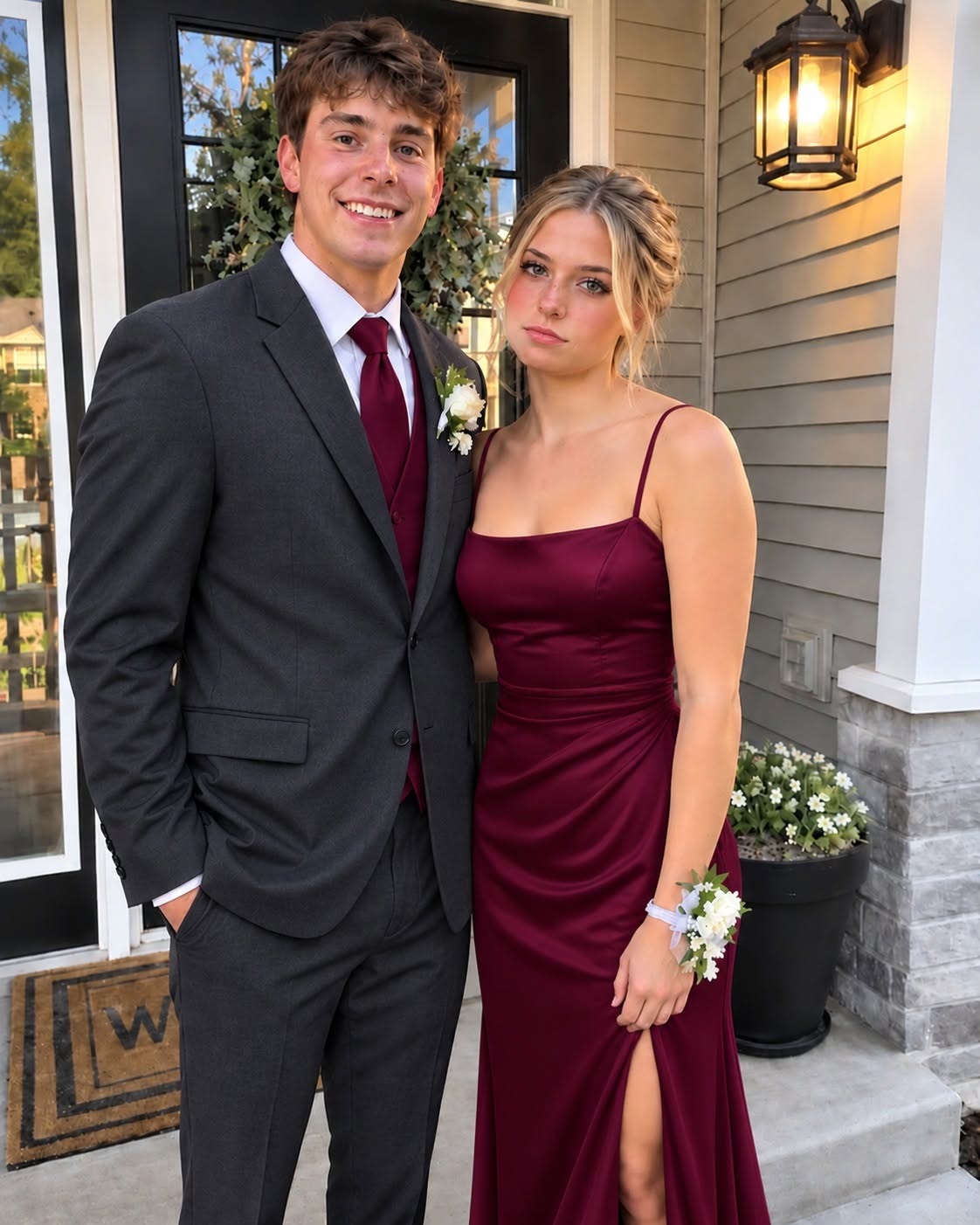
The next evening, I borrowed my uncle’s car, put on my only suit, and drove to Sheldon’s house.
He met me at the door.
For some reason, he seemed more nervous than Georgia.
“Just make sure she has a good night,” he said.
Then Georgia came downstairs.
She looked beautiful, but the moment she saw me, her smile vanished.
She said almost nothing while her father took pictures.
The drive to prom was painfully quiet.
I tried asking Georgia about her friends, the music she liked, and even whether she was excited about the dance.
She answered with a few words, then turned back toward the window.
Eventually, I stopped trying.
When we pulled up outside the venue, I turned off the engine.
“Well,” I said, forcing a smile. “I hope tonight won’t be too terrible. I guess your dad really wanted you to go to prom.”
Georgia didn’t smile back.
She opened the passenger door but didn’t step out.
Instead, she turned to me and looked me straight in the eyes.
“Wait.”
I looked at her.
“My dad didn’t choose you by accident. And it wasn’t for my sake.”
For several seconds, neither of us moved.
Outside, teenagers in dresses and rented tuxedos crossed beneath strings of white lights leading to the ballroom entrance. Music pulsed faintly through the walls.
I stared at Georgia.
“What does that mean?”
She closed the passenger door again.
Whatever nervousness I’d noticed before was gone from her face now. What replaced it was something heavier.
“I need you to promise not to go storming back to my house.”
“I don’t even know what you’re talking about.”
“I know.”
“Then explain it.”
Georgia looked through the windshield.
“My dad knows your family.”
I almost laughed.
“My family?”
“Your father.”
The laugh died before it came out.
I didn’t talk about my father much.
His name was Martin Hale.
He had died when I was seven.
At least, that was how I thought of it—an event more than a person. I remembered fragments: a rough hand lifting me onto a kitchen counter, the smell of sawdust on his jacket, a voice singing badly in the car.
Then hospital corridors.
Adults whispering.
Mom crying behind a bathroom door because she didn’t want me to hear.
Afterward, his name slowly disappeared from ordinary conversation.
“What does Sheldon have to do with my dad?”
Georgia reached for the small silver purse on her lap.
She removed a folded piece of paper.
“I found this three days ago.”
I didn’t take it.
“What is it?”
“I was looking for my birth certificate.”
“In your father’s office?”
“He keeps all our important paperwork in the safe.”
“And you just happened to go through everything?”
She gave me a look.
“I was bored.”
Despite everything, I almost smiled.
Then she held the paper out.
“Brent.”
Something about the way she said my name made me take it.
The sheet wasn’t original. It was a photocopy.
At the top was a faded company logo.
**FARRELL & HALE DISTRIBUTION SERVICES**
I read it again.
Farrell.
Sheldon’s last name.
Hale.
Mine.
My fingers tightened around the paper.
“What is this?”
“Keep reading.”
Below the company name were several paragraphs of legal language I didn’t understand.
But I understood the signatures at the bottom.
**Sheldon Farrell.**
And beside it:
**Martin Hale.**
My father.
Dated seventeen years earlier.
I felt as if the interior of the car had become smaller.
“My dad worked with Sheldon?”
Georgia shook her head.
“Not for him.”
She pointed toward the top.
“With him.”
I stared at her.
“They started the company together.”
I looked down again.
The business where I had spent almost a year stacking boxes, driving deliveries, balancing receipts and sweeping floors at closing time had once carried my father’s name.
Yet in all that time, Sheldon had never mentioned him.
Not once.
“That’s impossible.”
“I don’t think it is.”
“My mom would’ve told me.”
“Maybe.”
I looked sharply at her.
“What does that mean?”
“It means I don’t know what your mom knows.”
Georgia took a breath.
“I asked my dad about the document.”
“And?”
“He went completely quiet.”
“Quiet how?”
“Like I had asked the one question he’d spent years hoping nobody would ask.”
A group of students passed our car laughing.
For a moment, I was absurdly aware of how normal everything looked.
A boy adjusted his tie.
A girl complained about her shoes.
Someone took pictures beneath a flowering tree.
Meanwhile, my entire understanding of the man I worked for was coming apart in the front seat of my uncle’s Buick.
“What did he tell you?”
“Almost nothing. He said your father had been his business partner a long time ago. Then he told me not to bring it up with you.”
That made something cold settle inside me.
“And the next day he asked me to take you to prom,” I said.
“No.”
Georgia looked at me.
“The next day he asked *you* to take *me*.”
I understood her point.
“He wanted us together.”
“Yes.”
“Why?”
“I don’t know.”
She reached into her purse again.
This time she produced a small envelope.
My name was written across the front.
Not printed.
Handwritten.
**BRENT HALE**
I recognized Sheldon’s handwriting from work orders.
“He gave me this before you arrived tonight,” Georgia said.
I stared at it.
“He told me to give it to you?”
“At midnight.”
“Why midnight?”
“He wouldn’t say.”
“Have you opened it?”
“No.”
“You opened his safe but not this?”
“There’s a difference between curiosity and committing a felony in formalwear.”
I stared at her.
She shrugged.
“Humor helps when my father behaves like a spy.”
I almost laughed again, but the envelope stopped me.
“Why tell me now?”
Georgia’s expression changed.
“Because I don’t like being used.”
Something in her voice made me realize this evening had been strange for her too.
“The boy who was supposed to take me didn’t back out yesterday,” she said.
“When did he?”
“Three weeks ago.”
I frowned.
“Your dad told me it just happened.”
“I know.”
“So Sheldon waited three weeks and then suddenly decided I was your emergency date?”
“Exactly.”
I looked back at the envelope.
“This is crazy.”
“Probably.”
“Your father could’ve called me into his office and handed me this.”
“Yes.”
“Instead he arranged all this.”
“Yes.”
“Why?”
Georgia stared at the envelope too.
“That’s the part that’s bothering me.”
We sat quietly.
Then I reached toward it.
Georgia pulled it back.
“Midnight.”
“Seriously?”
“Those were his instructions.”
“You’re following his instructions now?”
“No. I’m trying to understand why the time matters.”
I glanced at the dashboard clock.
7:42.
Four hours and eighteen minutes.
I couldn’t imagine walking into a ballroom and pretending to enjoy prom while that envelope sat inside Georgia’s purse.
“We’re opening it.”
“Brent—”
“Now.”
She considered me.
Then nodded.
“Okay.”
She handed it over.
I slid one finger beneath the flap.
Inside was a single sheet of paper.
A short note.
I unfolded it.
Brent,
There are things about your father I should have told you years ago.
There are also things I promised him I wouldn’t tell you until the right time.
I realize now there may never be a right time.
Georgia found documents that weren’t meant to remain hidden forever. I suspect she has already told you more than I asked her to.
At midnight, a legal restriction connected to your father’s original partnership expires.
After that, you have the right to see everything.
I am sorry I didn’t have the courage to tell you myself.
Do not make any decisions tonight.
—Sheldon
I read it twice.
Then a third time.
Georgia leaned toward me.
“What does it say?”
I handed it to her.
She read silently.
When she finished, she looked at the dashboard clock.
“So that’s why midnight matters.”
“A legal restriction?”
“I don’t know.”
“Your dad owns the company.”
“Mostly.”
“Mostly?”
She hesitated.
That hesitation was becoming something I hated.
“Georgia.”
“There was another document.”
Of course there was.
“What document?”
“I didn’t have time to copy it.”
“What did it say?”
“I only saw the first page.”
“Georgia.”
She looked directly at me.
“It listed ownership percentages.”
My heartbeat seemed to slow.
“Okay.”
“My father had seventy-five percent.”
I waited.
She didn’t continue.
“And?”
“The other twenty-five percent was beside your father’s name.”
I stared at her.
“He died thirteen years ago.”
“I know.”
“So somebody would’ve inherited it.”
“I know.”
“My mom?”
“Maybe.”
“Then why am I working there for twelve dollars an hour?”
Georgia winced.
I hadn’t meant to sound angry at her.
I ran both hands over my face.
“No. Sorry.”
“You don’t have to apologize.”
“I don’t know what’s happening.”
“Neither do I.”
I stared out the windshield at the glowing ballroom.
For the first time, the promise Sheldon had made echoed through my head.
*I’ll make it worth your while.*
Earlier, I had assumed he meant a bonus.
Fifty dollars.
Maybe a hundred.
Enough groceries to help Mom.
Enough to buy my sister the calculator she needed for school.
Now the words sounded completely different.
Georgia seemed to be thinking the same thing.
“Do you think he was talking about money?” she asked.
“I don’t know.”
“Brent…”
“What?”
“There was something else in the safe.”
I didn’t want another revelation.
I wanted twenty-four hours ago.
I wanted my biggest problem to be figuring out whether my borrowed suit looked ridiculous.
But I asked anyway.
“What?”
“A photograph.”
“Of what?”
“My father.”
She paused.
“And your dad.”
That wasn’t surprising anymore.
Then she added:
“And your mother.”
My head snapped toward her.
“Mom?”
Georgia nodded.
“They were young. Maybe twenty-five.”
“So?”
“So they weren’t just standing together.”
She lowered her voice.
“They were in front of the building where you work.”
I felt my stomach tighten.
“And the sign behind them said Farrell & Hale.”
I looked down at Sheldon’s letter.
For nearly a year, I had walked through those doors every morning.
My mother had never mentioned that she had stood outside them decades earlier.
Not once.
Georgia reached for the door handle.
“We should go inside.”
“You actually want to attend prom now?”
“No.”
For the first time that evening, she smiled.
“But if we’re going to discover our parents have been hiding half their lives from us, I refuse to do it hungry.”
That startled a laugh out of me.
A real one.
Georgia climbed from the car.
I followed.
For the next three hours, we did something neither of us expected.
We actually had fun.
Not constantly.
The unanswered questions were always there, hovering behind every conversation.
But we ate.
We talked.
Georgia introduced me to friends who seemed relieved she had come at all. I learned she wanted to study architecture, though Sheldon wanted her to attend business school.
She learned that I had postponed community college because my family needed the money.
At one point, she looked at me across the table.
“You know what bothers me?”
“Only one thing?”
“My dad talks about you.”
I stopped.
“What does he say?”
“That you’re dependable. That you don’t cut corners. That when everybody else disappears during inventory week, you’re still there.”
I looked away.
“That doesn’t mean anything.”
“It means he’s been watching you.”
I didn’t like the phrase.
Georgia noticed.
“Not in a creepy way.”
“Excellent clarification.”
“You know what I mean.”
Maybe I did.
Around eleven thirty, the music slowed.
Couples gathered near the dance floor.
Georgia looked toward them.
Then at me.
“We’ve come this far.”
“I don’t dance.”
“Neither do half of them.”
“I really don’t dance.”
“My entire evening has been built around my father’s seventeen-year-old corporate mystery. You owe me one dance.”
“Technically your father owes both of us.”
She laughed.
“Fair.”
But I stood anyway.
We danced badly.
Georgia stepped on my shoe twice.
I almost walked backward into another couple.
And for three minutes, everything felt ordinary.
Maybe that’s why what happened next hit harder.
At 11:57, Georgia’s phone buzzed.
She looked at the screen.
Her smile disappeared.
“What?”
“It’s my dad.”
“Answer it.”
She did.
“Dad?”
I watched her face.
“What do you mean?”
A pause.
“No, we’re still here.”
Another pause.
“Why?”
Her eyes moved toward me.
Then widened.
“Okay.”
The call ended.
“What happened?”
Georgia lowered the phone slowly.
“My father said we shouldn’t come home.”
“Why?”
“He didn’t say.”
“Did something happen?”
“He said he’s going to your house.”
My mouth went dry.
“My house?”
She nodded.
“Why?”
“He said he needs to talk to your mother before midnight.”
I checked the time.
11:58.
“Let’s go.”
We hurried through the ballroom.
By the time we reached the car, my phone was ringing.
Mom.
I answered immediately.
“Mom?”
For a moment I heard nothing.
Then her voice.
“Brent.”
Something was wrong.
She sounded like she’d been crying.
“What’s happening?”
“Where are you?”
“Leaving prom. Sheldon called Georgia. He said he’s coming to our house.”
A long silence.
Then Mom whispered something that stopped me beside the driver’s door.
“What?”
She repeated it.
“I said Sheldon is already here.”
I looked at Georgia.
“Why?”
Mom inhaled shakily.
“Because apparently it’s time you learned what your father left behind.”
I gripped the phone.
“What did Dad leave?”
Another silence.
Then Mom said:
“Not money.”
Behind her, I heard a man’s voice.
Sheldon.
Then Mom spoke again.
“He left you a choice.”
“A choice about what?”
Her answer came just as the clock on the dashboard turned midnight.
“About whether the company should ever have belonged to Sheldon at all.”
**-END OF Chapter 1–**
*Part 2 of 5*
Georgia and I didn’t talk much on the drive to my house.
There are kinds of silence that feel empty.
This wasn’t one of them.
This silence was crowded.
My father’s signature.
The photograph.
Sheldon’s letter.
Twenty-five percent.
My mother’s voice.
*Whether the company should ever have belonged to Sheldon at all.*
Every traffic light felt too long.
Georgia sat beside me holding her shoes in her lap because she’d kicked them off before we left the ballroom.
After several minutes, she said, “You’re driving too fast.”
I checked the speedometer.
She was right.
I slowed down.
“Sorry.”
“You don’t have to apologize for everything.”
“I’m discovering that tonight.”
She looked out the window.
“Whatever happens, remember one thing.”
“What?”
“You worked for my dad almost a year without knowing any of this.”
“Meaning?”
“Meaning whatever is in those papers doesn’t change who you were yesterday.”
At the time, I didn’t understand why I would need to hear that.
Twenty minutes later, I did.
Sheldon’s sedan was parked outside our small rental house.
The porch light was on.
My mother was sitting at the kitchen table when we entered.
Sheldon sat across from her.
Between them lay a wooden box I’d never seen before.
My sister, Molly, was nowhere in sight.
“Where’s Molly?” I asked.
“At Aunt Carol’s,” Mom said. “I asked her to stay there tonight.”
That frightened me more than anything so far.
Mom looked at Georgia.
“Hello, Georgia.”
Georgia froze slightly.
“You know who I am?”
Mom gave a tired smile.
“I knew you when you were small enough to sleep in a laundry basket.”
Georgia stared at her.
Sheldon closed his eyes.
“Dad?”
“I told you they knew each other,” he said.
“No. You told me you knew Brent’s father.”
“I should have told you more.”
“That’s becoming a popular sentence tonight.”
Sheldon accepted that without argument.
I remained standing.
“What is the box?”
Mom touched the lid.
“Your father’s.”
“Where has it been?”
“With Sheldon.”
I looked at him.
“For thirteen years?”
“Yes.”
“Why?”
Sheldon stood.
“Because your father asked me to keep it.”
“Why not my mother?”
Mom answered.
“Because I didn’t want it.”
That hurt more than I expected.
She saw my face.
“Not you, Brent. The company. The arguments. The lawyers. Everything connected to those last few years.”
“What arguments?”
Mom looked toward Sheldon.
“No more half-truths,” she said.
He nodded.
Then she opened the box.
Inside were photographs, letters, notebooks, and a thick folder tied with faded blue string.
Mom removed the folder.
“Your father and Sheldon started the company when they were twenty-four.”
I sat down.
Georgia took the chair beside me.
“They had one truck,” Mom continued. “Then two. Then five. Martin handled customers and operations. Sheldon handled finances.”
Sheldon smiled faintly.
“Your father could convince anyone to give us a chance.”
Mom’s eyes softened.
“He could convince anyone of almost anything.”
For a moment, I could hear affection in her voice.
Then it disappeared.
“The business grew quickly. Too quickly, probably. They borrowed money. Hired people. Bought the warehouse.”
“What happened?”
Sheldon answered.
“We disagreed about what came next.”
“Meaning?”
“Martin wanted to slow down. I wanted to expand.”
Mom gave him a look.
“You wanted to gamble.”
Sheldon nodded.
“That’s fair.”
“So Dad wanted out?”
“Not exactly.”
Sheldon sat again.
“He wanted the company divided. I wanted to buy his share.”
I looked at the folder.
“Did you?”
“No.”
“Why not?”
“Because I couldn’t afford it.”
That surprised me.
Sheldon had always seemed financially secure.
Maybe I’d confused stability with wealth.
“So what happened?”
“Your father made me an offer,” Sheldon said. “He would step away from daily operations. I would run the company. His twenty-five percent would remain untouched.”
“Until when?”
“Until you turned twenty-one.”
I stared at him.
“Me?”
“He wanted you to choose.”
The phrase returned.
The choice.
“Choose what?”
“Whether you wanted his interest in the business.”
I shook my head.
“Why me?”
Mom gave a small sad laugh.
“Because fathers sometimes make plans for children who are still learning multiplication.”
She pushed a document toward me.
It was a partnership agreement.
Near the bottom, beneath several paragraphs of legal language, was a handwritten clause.
Upon Martin Hale’s death, his interest would transfer into trust.
Beneficiary:
**Brent Martin Hale.**
I couldn’t breathe normally.
“Why didn’t anyone tell me?”
“Because there was another condition,” Sheldon said.
He removed another paper.
This one was handwritten.
My father’s writing.
I recognized it from birthday cards Mom had saved.
The sight of it almost undid me.
Sheldon read:
“If Brent reaches adulthood and wants nothing to do with the company, let him walk away without obligation. Do not burden him with a business simply because I helped build it.”
I swallowed.
Sheldon continued.
“If Brent ever comes to work for you before learning the truth, do not tell him immediately. Let him discover whether the work suits him when he believes he has nothing to gain.”
I stared at the page.
Georgia whispered, “Wow.”
I looked at Sheldon.
“You’ve been testing me.”
His face tightened.
“I wouldn’t call it that.”
“What would you call it?”
“Trying to honor your father’s wishes badly.”
“You watched me unload trucks and mop floors while knowing I might own part of the place.”
“Yes.”
“You watched me work overtime because I needed money.”
His eyes lowered.
“Yes.”
Anger came slowly.
That surprised me.
I’d expected an explosion.
Instead it felt like water rising around my ankles.
“You knew about Mom?”
“Yes.”
“You knew about Molly?”
“Yes.”
“You knew we were struggling?”
“Not how much.”
“You could’ve asked.”
“I should have.”
Mom interrupted.
“Brent, I asked him not to interfere.”
I turned toward her.
“What?”
Her hands were folded tightly.
“After your father died, Sheldon offered money. Several times.”
“And you said no?”
“Yes.”
“Why?”
“Because at the time, every conversation about that company turned into another argument about what Martin had intended. I had just lost my husband. I had a seven-year-old. I couldn’t spend years fighting over contracts.”
“You wouldn’t have been fighting.”
Mom looked at me.
“You don’t know that.”
Sheldon said quietly, “She’s right.”
I turned to him.
“The trust wasn’t simple. Martin’s ownership was never properly converted after the company reorganized. There were questions about valuation, control, and debt. Lawyers disagreed.”
“So what happened to the twenty-five percent?”
“It remained unresolved.”
“For thirteen years?”
“Yes.”
“How is that possible?”
“Because no one forced the issue.”
Mom looked ashamed.
“And because I signed an agreement.”
Georgia leaned forward.
“What agreement?”
Mom removed another paper.
“When Martin died, I signed temporary control to Sheldon until Brent reached the age specified in the trust.”
“Twenty-one,” I said.
She nodded.
I felt confused.
“I’m not twenty-one.”
“No.”
“So why tonight?”
Sheldon answered.
“Because the original agreement had another date.”
He tapped the document.
“Georgia’s eighteenth birthday.”
Georgia blinked.
“My birthday was two months ago.”
“Yes.”
“And what does that have to do with Brent?”
Sheldon took a long breath.
“Your mother.”
Georgia became very still.
Her mother, Evelyn, had died four years earlier.
Sheldon rarely spoke about her.
“Mom was involved?”
“She witnessed the agreement.”
“That’s all?”
“No.”
Georgia’s voice sharpened.
“Dad.”
Sheldon looked toward his daughter.
“Your mother was the attorney who drafted it.”
Georgia stared at him.
“My mother was a corporate attorney?”
“Before you were born.”
“You told me she worked in real estate.”
“Later, she did.”
Georgia stood.
“Why does everyone in this room apparently have an entire life nobody bothered to tell me about?”
Her voice wasn’t loud.
That made it more powerful.
Sheldon started to speak.
She shook her head.
“No. Don’t explain yet.”
Then she turned toward my mother.
“You knew my mom?”
Mom nodded.
“She was my friend.”
Georgia’s face changed.
Not anger.
Pain.
“My mother died when I was fourteen.”
“I know.”
“You came to her funeral?”
“Yes.”
“I don’t remember you.”
“You were surrounded by people.”
“Did you ever think about telling me?”
“Many times.”
“Why didn’t you?”
Mom looked at Sheldon.
Georgia followed her gaze.
“Dad?”
Sheldon rubbed his forehead.
“Evelyn believed the agreement shouldn’t affect either of you until you were old enough to understand it.”
“What agreement?”
He removed a sealed envelope from the box.
Georgia’s name was written across it.
“Your mother left this with me.”
Georgia stared.
“When?”
“Two weeks before she died.”
The room went completely silent.
Georgia sank slowly back into her chair.
Her hand trembled as she reached for the envelope.
Sheldon didn’t stop her.
She opened it.
Inside were several pages.
Georgia read the first silently.
Then she covered her mouth.
“What?”
I asked.
She looked at me.
“My mom knew your dad.”
“I gathered that.”
“No.”
She shook her head.
“She knew what he wanted.”
She passed the first page to me.
Evelyn had written the letter to Georgia.
Most of it was personal.
She talked about watching Georgia grow.
About regretting that she wouldn’t see graduation.
About hoping Sheldon would learn that loving someone didn’t mean arranging every part of their life.
Georgia let out a short laugh when I read that.
“She knew him.”
Then I reached the paragraph near the bottom.
There is another reason I am writing this now.
Years ago, I made a promise to Martin Hale.
His son was seven then.
You were barely old enough to walk.
Martin was afraid Sheldon and Anna would spend the rest of their lives protecting their children from truths those children might someday need.
He made me promise that when you were old enough, you would be given a choice too.
I stopped.
“What choice?”
Georgia had already turned the page.
Her eyes moved rapidly across it.
Then she whispered:
“Oh.”
“What?”
She passed it to Sheldon.
He didn’t take it.
“I know what it says.”
“Then say it.”
He looked at both of us.
“Your father didn’t leave Brent twenty-five percent of the company.”
My anger returned.
“You just showed me the agreement.”
“He left you the right to claim it.”
“What’s the difference?”
“A large one.”
He pointed toward Evelyn’s letter.
“If you claim your father’s interest, Georgia receives something too.”
Georgia looked stunned.
“What?”
Sheldon continued.
“Voting control over my shares until she’s twenty-five.”
Nobody spoke.
Then I understood.
If I claimed my father’s share, Georgia would temporarily control Sheldon’s majority interest.
Meaning the decision wasn’t merely about money.
It would change the company.
It would change Sheldon’s life.
My life.
Georgia’s.
Everything.
“Why would Dad do that?” I asked.
Sheldon looked at the wooden box.
“Because Martin didn’t trust either of us.”
“Either of who?”
“Me.”
Then he looked at my mother.
“And your mother.”
Mom closed her eyes.
I stared at them.
Georgia whispered, “There’s more, isn’t there?”
Mom opened her eyes.
“Yes.”
She reached into the box and removed one final letter.
“This one is for Brent.”
I recognized my father’s handwriting immediately.
My name was written across the front.
Beneath it were six words.
**Only if he works for Sheldon.**
My hands went cold.
Sheldon spoke quietly.
“Your father wrote that letter seventeen years ago.”
I looked at him.
“Before he died?”
“Yes.”
“He somehow predicted I’d work for you?”
“No.”
Sheldon shook his head.
“He hoped you never would.”
I stared at the envelope.
“Why?”
Mom answered before Sheldon could.
“Because the last time your father walked out of that company, he told me he never wanted his son anywhere near it.”
**-END OF Chapter 2–**
*Part 3 of 5*
Nobody opened my father’s letter for me.
That mattered.
After a night full of other people deciding what I should know and when I should know it, that envelope remained untouched until I chose to break the seal.
I didn’t do it immediately.
Instead I carried it outside.
The porch steps were cool beneath me.
A few minutes later, the screen door opened.
Georgia stepped out.
She had changed out of her heels and was barefoot.
“Mind if I sit?”
“It’s technically my porch.”
“So that’s a no?”
I moved over.
She sat beside me.
For a while, neither of us spoke.
The neighborhood was quiet.
Somewhere down the street, a sprinkler clicked rhythmically.
“You okay?” I asked.
Georgia looked at me.
“You just discovered your father left you part of a company and a letter apparently warning you away from it.”
“True.”
“And you’re asking me?”
“Your dead mother apparently gave you temporary control of your father’s company depending on what I decide.”
“When you say it aloud, prom sounds less complicated.”
I laughed despite myself.
She did too.
Then her face grew serious.
“I don’t want it.”
“What?”
“Control of the company.”
“You don’t even know what it means yet.”
“Exactly.”
She wrapped her arms around her knees.
“That’s what bothers me. Our parents arranged this thing when we were children. Now we’re expected to walk into some plan they built for people who didn’t exist yet.”
“We existed.”
“You know what I mean.”
I did.
She looked toward the envelope.
“Are you going to read it?”
“I think so.”
“Do you want me to leave?”
I considered the question.
“No.”
So I opened it.
The letter began simply.
**Dear Brent,**
I stopped at those two words.
There is something unbearable about seeing yourself addressed by someone whose voice you can barely remember.
I continued.
If you are reading this, then you have done the one thing I hoped you would never feel obligated to do.
You went to work for Sheldon.
That does not mean Sheldon is a bad man.
It means I failed to make our disagreements small enough that they wouldn’t reach you.
I looked toward the front window.
Through the curtain I could see Sheldon sitting at our kitchen table.
My mother stood near the sink.
My father had somehow known their conflict might outlive him.
I kept reading.
Sheldon and I built Farrell & Hale because we were young enough to believe friendship made contracts unnecessary.
We were wrong.
We also believed success would solve disagreements.
It multiplied them.
Sheldon wanted growth.
I wanted stability.
Neither of us was completely right.
Neither of us was completely wrong.
That surprised me.
I had expected accusation.
Instead my father sounded almost tired.
Then came the part that changed everything.
I made a serious mistake during our final year working together.
I authorized an expansion we could not afford because I wanted to prove Sheldon wrong.
It failed.
The company nearly collapsed.
For years afterward, everyone simplified the story.
Sheldon was ambitious.
I was cautious.
That version was convenient.
It was also false.
I lowered the paper.
Georgia watched me carefully.
“What?”
“He says he almost destroyed the company.”
She didn’t answer.
I continued.
Sheldon saved the business by using nearly everything he owned as collateral.
I resented him for succeeding where I had failed.
That resentment damaged our friendship more than money ever could.
If Sheldon still has this letter, it means he kept a promise I wasn’t always certain he deserved to carry.
Do not inherit my anger.
I read that line twice.
*Do not inherit my anger.*
I had spent the evening preparing myself to discover a villain.
Apparently my father had anticipated that too.
Then I reached the final section.
My share in the company is yours only if you want it for reasons that are your own.
Not because I built it.
Not because Sheldon kept it.
Not because your mother sacrificed for you.
If you worked there before knowing who I was, ask yourself a simple question:
May you like

Would you return tomorrow if there were no inheritance?
Your answer matters more than any percentage on a piece of paper.
And there is one final truth your mother may never forgive me for leaving you to discover.
She didn’t keep you from the company because she hated Sheldon.
She kept you away because she once intended to run it herself.
I stopped.
Georgia leaned closer.
“What?”
I handed her the page.
She read.
Then looked toward the house.
“Your mom?”
“Apparently.”
I stood.
This time, I wasn’t angry.
I was bewildered.
Mom was still in the kitchen when I walked inside.
I placed the letter before her.
She read the last paragraph.
For several seconds she didn’t speak.
Then she laughed.
Not because anything was funny.
It was the exhausted laugh of someone realizing a secret had finally caught up with her.
“Martin always had terrible timing.”
“You were going to run the company?”
She sat.
“Before you were born, yes.”
Sheldon watched her.
Mom continued.
“I did bookkeeping at first. Then scheduling. Customers started calling me instead of Sheldon or your father because I was usually the only person who knew where anything was.”
Georgia smiled slightly.
“That sounds familiar.”
Sheldon nodded.
“It does.”
Mom looked down.
“When you were born, I stepped away for a while. I planned to return.”
“But you didn’t.”
“No.”
“Why?”
“Because the company became the center of every argument your father and I had.”
She looked at Sheldon.
“And every argument Martin and Sheldon had.”
“So you walked away.”
“I chose you.”
Something about that answer bothered me.
“Those aren’t the same thing.”
Mom looked surprised.
“You shouldn’t have had to choose.”
A long silence followed.
Finally, Mom nodded.
“You’re right.”
It was the first time that night an adult had admitted something without explaining it away.
Sheldon leaned back.
“For what it’s worth, your mother was better at operations than either of us.”
Mom gave him a sideways look.
“That’s worth very little seventeen years late.”
“Still true.”
For the first time, the tension between them softened.
I sat.
“What happens now?”
Sheldon folded his hands.
“Nothing tonight.”
“That’s what your letter said.”
“I meant it.”
“And the promise to make prom worth my while?”
He winced.
Georgia laughed.
“You really should explain that.”
Sheldon looked embarrassed.
“I had planned to give Brent a bonus.”
I stared at him.
“Seriously?”
“Yes.”
“After all this?”
“I needed a believable reason for you to agree.”
Georgia groaned.
“Dad.”
“What?”
“That’s terrible.”
“I know.”
Despite myself, I laughed.
And somehow, that broke something open.
For ten minutes, nobody talked about trusts or ownership.
Mom made coffee.
Georgia found leftover pie in the refrigerator.
Sheldon removed his jacket.
The night became strange in a different way.
Human.
Eventually I asked the question that mattered.
“Why did you hire me?”
Sheldon met my eyes.
“Your application came through normally.”
“You didn’t arrange it?”
“No.”
“Did you recognize my name?”
“Immediately.”
“And you hired me because of Dad.”
Sheldon hesitated.
“Partly.”
I felt disappointment.
“But not entirely.”
He stood and walked toward the wooden box.
Then he removed a folded evaluation form.
“Your first interview.”
I remembered it.
I had been terrified.
Sheldon had barely looked at me.
“Three supervisors interviewed applicants,” he said. “You ranked first with two of them.”
“Who was the third?”
“Me.”
“And?”
“You ranked fourth.”
Georgia burst out laughing.
I stared at him.
“Fourth?”
“You were nervous.”
“I needed a job.”
“You knocked over my coffee.”
“I remember.”
“And then apologized six times.”
“That sounds like Brent,” Georgia said.
I pointed at her.
“You have known me for five hours.”
“Enough time.”
Sheldon continued.
“I considered rejecting you because of your father.”
That surprised me.
“Why?”
“Because I knew exactly what hiring you might eventually mean.”
“The trust.”
“Yes.”
“Then why didn’t you reject me?”
“Because your manager told me something.”
“What?”
“That if I removed your last name from the application, you were still the best candidate.”
That quieted me.
So there it was.
Not destiny.
Not manipulation.
Not entirely.
A job application.
A nervous interview.
A supervisor who liked me.
And a man with an old promise deciding not to interfere.
“Why choose tonight?” I asked.
Sheldon looked toward Georgia.
“Because she found the papers.”
“So if she hadn’t?”
“I would have waited.”
“Until I turned twenty-one?”
“Probably.”
Georgia shook her head.
“And this is why Mom didn’t trust you to decide everything.”
Sheldon accepted that.
“Probably.”
I looked at Dad’s letter again.
*Would you return tomorrow if there were no inheritance?*
I already knew the answer.
Yes.
I liked the work.
Not every part.
Nobody loves counting damaged cartons at seven in the morning.
But I liked being useful.
I liked knowing customers.
I liked figuring out routes.
I liked the moment at closing when the warehouse finally went quiet and I knew we’d finished what we’d promised.
But knowing I would return didn’t mean I wanted the company handed to me.
“I don’t want twenty-five percent tomorrow.”
Sheldon nodded.
“Good.”
I frowned.
“Good?”
“Yes.”
“Why?”
“Because anyone who learns at one in the morning that they may own a quarter of a company and immediately says yes shouldn’t own a quarter of a company.”
Georgia smiled.
“That may be the smartest thing you’ve said tonight.”
Sheldon looked offended.
“I’ve said several smart things.”
“Name two.”
He couldn’t.
Mom laughed.
It was nearly three when Sheldon and Georgia finally prepared to leave.
Before they did, Mom gave Georgia a photograph.
The one from the safe.
Georgia stared at it.
Four young adults stood outside the warehouse.
Sheldon.
My father.
My mother.
Evelyn.
They looked ridiculously young.
My father had his arm around Sheldon.
Mom and Evelyn were laughing about something.
Nobody looked like they were carrying a secret that would last nearly two decades.
Georgia traced her mother’s face with one finger.
“I don’t remember her looking this young.”
Mom smiled.
“None of us remember our parents being young.”
Georgia held the photograph carefully.
Then she frowned.
“What?”
I asked.
She turned it over.
Something was written on the back.
Four names.
A date.
And below them:
**When we finally buy Bellweather, no one gets to own it alone.**
Georgia stared at me.
“Bellweather.”
“What?”
She swallowed.
“The place where prom was tonight.”
I looked at Sheldon.
His face had gone pale.
“What does that mean?” I asked.
He didn’t answer.
Georgia held up the photograph.
“Dad.”
Sheldon stared at the words.
Then he sat down again.
Mom whispered, “I forgot about that.”
“Forgot about what?”
Nobody answered immediately.
I felt the old tension return.
Finally Sheldon said:
“The ballroom where you went tonight used to belong to the company.”
Georgia blinked.
“Our company?”
“No.”
He shook his head.
“Another company.”
“What company?”
Sheldon looked at my mother.
Mom looked away.
And suddenly I understood there was still something everyone in that room had avoided discussing.
Not Farrell & Hale.
Something older.
Something involving all four people in the photograph.
“Who owned Bellweather?” I asked.
Sheldon answered quietly.
“Your grandfather.”
I stared at him.
“My mother’s father?”
“No.”
He looked directly at me.
“Mine.”
Georgia frowned.
“Then why is Brent’s father talking about buying it?”
Sheldon took the photograph.
“Because Martin believed my father had cheated all four of us.”
The room fell silent.
Then he added:
“And before he died, Martin believed he’d finally found proof.”
**-END OF Chapter 3–**
*Part 4 of 5*
I slept for three hours.
At eight the next morning, I woke to the smell of pancakes and the uncomfortable realization that the strangest night of my life had not been a dream.
My suit jacket hung over a chair.
My father’s letter sat on the dresser.
For several minutes, I stared at the ceiling.
Then Molly knocked.
“Are you awake?”
“No.”
She entered anyway.
At fifteen, my sister had developed an extraordinary ability to ignore answers she didn’t like.
She sat on the edge of my bed.
“Mom said something happened last night.”
“Something happened.”
“Did your date dump you?”
“No.”
“Did you dump her?”
“No.”
“Did you kiss her?”
“Molly.”
“I’m gathering information.”
I threw a pillow at her.
She caught it.
Then her expression softened.
“Mom cried this morning.”
That erased my annoyance.
“Is she okay?”
“She said she is.”
Mom’s definition of okay had always been suspiciously broad.
I found her downstairs.
She was flipping pancakes with the concentration of a person trying not to think.
“Morning.”
“Morning.”
I sat.
“Are we going to talk about Bellweather?”
The spatula stopped.
“After breakfast.”
“Mom.”
“After breakfast.”
There was no arguing with that voice.
Twenty minutes later, Molly left for a friend’s house under obvious protest.
Then Mom brought the wooden box to the table.
“Your grandfather wasn’t involved,” she said.
“Sheldon said his father owned Bellweather.”
“He did.”
“So why was Dad involved?”
“Because Bellweather wasn’t always a ballroom.”
She removed another photograph.
A brick industrial building stood beside railway tracks.
“That is Bellweather?”
“Forty years ago.”
“What was it?”
“A regional distribution depot.”
I stared at the picture.
“That’s why Dad wanted it.”
“Yes.”
Farrell & Hale had needed warehouse space.
Sheldon’s father, Arthur Farrell, owned Bellweather through another business.
“He agreed to sell it to Martin and Sheldon,” Mom explained. “Evelyn and I planned to invest too.”
“All four of you.”
“Yes.”
“What happened?”
“The deal disappeared.”
“What does that mean?”
“Arthur claimed someone else offered more money.”
“And Dad believed he lied.”
“Years later, yes.”
“Why?”
“Because the property wasn’t sold.”
I frowned.
“Then what happened to it?”
“Arthur transferred it into another company he controlled.”
The picture was becoming clearer.
“He blocked Sheldon from buying it?”
“Essentially.”
“Why?”
“Control.”
Mom looked tired.
“Arthur loved Sheldon. But he believed Sheldon needed his father’s judgment forever.”
I thought of Georgia.
Sheldon choosing her prom date.
Planning business school.
Arranging conversations instead of having them.
Patterns had long lives.
“What proof did Dad find?”
“I don’t know.”
“Sheldon thinks he found something.”
“Martin said he did.”
“Did you see it?”
“No.”
“Why does any of this matter now?”
Mom looked toward the window.
“Because Bellweather is worth a lot of money.”
“How much?”
“I don’t know.”
“And who owns it?”
She hesitated.
“That’s the problem.”
By noon, I was back at the warehouse.
It was Sunday and officially closed.
Sheldon, Georgia, Mom and I were the only people there.
Georgia wore jeans and an oversized sweater.
Seeing her without the prom dress made the previous night feel like something from another life.
“You look terrible,” she told me.
“Thank you.”
“I got four hours.”
“Three.”
“I win.”
“That’s not how sleep deprivation works.”
She handed me coffee.
“Peace offering.”
We joined our parents in Sheldon’s office.
For the first time, he unlocked the bottom drawer of his desk while I watched.
Inside was a red folder.
“Martin gave this to me six months before he died,” he said.
He placed it on the desk.
“Why wasn’t it in the box?”
“Because it wasn’t personal.”
Inside were property records, old letters, bank statements and handwritten notes.
Sheldon spread them out.
“My father controlled Bellweather through Farrell Holdings.”
Georgia leaned over the desk.
“What does this have to do with Mom?”
“Evelyn discovered that Arthur used money from our business to renovate Bellweather.”
My mother nodded.
“Money that should have belonged partly to Martin.”
“Did Arthur steal it?” I asked.
May you like
Sheldon shook his head.
“Not exactly.”
That answer had become familiar.
“He made loans between companies. Technically legal. Ethically questionable.”
“So Dad thought Farrell & Hale helped pay for Bellweather.”
“Yes.”
“And therefore the company had a claim?”
“Possibly.”
“Possibly?”
“Evelyn disagreed with Martin’s interpretation.”
Georgia looked surprised.
“My mom didn’t think there was a claim?”
“She thought there might be one, but not the one Martin wanted.”
“What did he want?”
Sheldon gave a small smile.
“He wanted to sue my father.”
“Did you?”
“No.”
“Why?”
“Because he was my father.”
Nobody had to explain that.
Loyalty made people irrational.
So did grief.
So did fear.
Georgia flipped through the documents.
“Then what proof did Martin supposedly find?”
Sheldon removed a small notebook.
“According to this, Arthur signed an option.”
“An option?”
“An agreement giving the four of us the right to buy Bellweather at a fixed price.”
Mom nodded.
“We remembered negotiating one.”
“But nobody could find the signed copy,” Sheldon said. “My father insisted it was never executed.”
“And Dad thought he found it.”
“Yes.”
“Where?”
“He never told me.”
That seemed absurd.
“He discovered proof and then hid it?”
“He said he needed time.”
“For what?”
“To decide whether using it would destroy what was left of our friendship.”
That sounded like my father’s letter.
Do not inherit my anger.
I began to understand him as a person rather than a photograph.
He could be stubborn.
Proud.
Wrong.
Afraid.
Capable of hurting people he loved while believing he was protecting them.
That realization made me miss him more, not less.
Georgia sat on the edge of the desk.
“Bellweather was renovated into the ballroom later?”
Sheldon nodded.
“My father sold it eight years ago.”
“To whom?”
“A hospitality company.”
“So whatever claim existed is ancient history.”
“Probably.”
“Then why are we discussing it?”
Mom answered.
“Because of the trust.”
Sheldon nodded.
“When Martin created Brent’s arrangement, he listed all unresolved partnership assets.”
I understood.
“Including Bellweather.”
“Yes.”
“And if there was a valid option?”
“Then your father’s estate may have retained a financial claim.”
“How large?”
“I don’t know.”
Georgia frowned.
“Wouldn’t attorneys handle this?”
“Yes.”
“Then why are we playing detective?”
Sheldon smiled.
“Excellent question.”
He closed the folder.
“Which is why I’m not asking either of you to investigate anything.”
Georgia stared at him.
“You brought us here.”
“To show you what exists.”
“And then?”
“Then Monday morning, I’ll call an attorney who has never represented me, Brent’s family, or the company.”
That was unexpectedly sensible.
Mom nodded.
“Good.”
“And until then,” Sheldon continued, “nobody makes assumptions.”
Georgia pointed toward him.
“Also unexpectedly sensible.”
“I’m improving.”
“Slightly.”
The tension eased.
Then I noticed something.
The photograph from last night was on the desk.
Bellweather.
My grandfather—or Sheldon’s grandfather, I corrected mentally.
I picked it up.
“What date was this taken?”
Mom told me.
June 14.
Seventeen years ago.
I looked through the folder.
The unsigned option was dated June 12.
Two days earlier.
“What’s this?” I asked.
Sheldon looked.
“Draft language.”
“The photograph says, ‘When we finally buy Bellweather.'”
“Yes.”
“So on June 14, they believed the deal was still happening.”
“Apparently.”
“When did Arthur say the option never existed?”
Sheldon searched another page.
“June 18.”
Four days.
Something had happened between the photograph and Arthur’s denial.
I turned the picture over again.
There were tiny numbers beneath the writing.
I’d assumed they were part of the date.
“What’s 314?”
Mom looked.
“I don’t know.”
Georgia leaned closer.
“Could be a room number.”
“Bellweather has rooms?”
“Offices upstairs.”
My heart sped up.
“What if Dad wasn’t writing a number?”
Sheldon took the photograph.
“Three-one-four.”
Georgia looked at me.
“March fourteenth?”
“No.”
I pointed to the original building photo.
On the side was a row of loading bays.
Each numbered.
309.
310.
311.
The last visible one was 313.
“Dock 314,” I said.
Sheldon looked at me.
Bellweather had been renovated years ago.
Any old loading dock was probably gone.
Still, Georgia pulled out her phone.
“What are you doing?”
“Searching pictures of the venue.”
She found a floor plan.
The ballroom occupied most of the original warehouse, but the rear storage section remained.
And along the back wall were old decorative steel doors left from the industrial building.
Numbered.
Georgia zoomed in.
311.
312.
313.
314.
Nobody spoke.
Finally Sheldon said:
“No.”
Georgia looked at him.
“No what?”
“We are not breaking into Bellweather.”
“I wasn’t suggesting that.”
“You were thinking it.”
“I was absolutely thinking it.”
Mom gave me a warning look.
“Nobody breaks into anything.”
And we didn’t.
We did something much less exciting.
We called the venue manager.
Sheldon explained that his family had once owned the property and asked whether we could look at one of the preserved loading bays.
The manager agreed to meet us that afternoon.
Reality, I discovered, often required fewer dramatic crimes than movies suggested.
At three thirty, the four of us stood behind Bellweather.
The building looked completely different in daylight.
The fairy lights were gone.
No limousines.
No music.
Just brick walls, trash bins and catering vans.
The manager, a woman named Denise, unlocked the old storage corridor.
“Most of these doors are decorative now,” she explained.
“What’s behind 314?” I asked.
“Maintenance closet.”
Of course it was.
We opened it.
Mops.
Cleaning supplies.
A broken chair.
Georgia looked at me.
“Congratulations, detective.”
“Give me a minute.”
Sheldon inspected the original brick wall.
Mom stood near the doorway.
Then she said something.
“Wait.”
She walked toward the back.
“What?”
“The numbers used to be reversed.”
We stared at her.
“When it was a depot, trucks entered from the east. Numbering started there.”
She pointed.
“After the ballroom renovation, they renumbered the doors from the west.”
Georgia checked the old photograph.
Mom was right.
Old 314 wasn’t current 314.
It was at the opposite end.
Current 306.
Denise led us there.
Another maintenance space.
This one contained electrical panels.
I felt foolish.
Until Georgia noticed scratches on the brick.
A rectangular outline.
“Something used to be mounted there.”
Denise nodded.
“Probably an old dispatch box.”
Sheldon went still.
“What?”
Mom asked.
“Martin used dispatch boxes.”
“For what?”
“Driver manifests. Keys. Documents.”
Denise searched a cabinet.
“You mean one of these?”
She removed an old metal box.
It was painted gray.
On the back, barely visible beneath rust, someone had scratched two initials.
**M.H.**
My father’s.
The box was locked.
Denise found a master key.
Inside were old route cards.
Pencils.
A receipt book.
And a yellow envelope.
Sheldon stared at it.
Mom covered her mouth.
The handwriting on the front belonged to Martin.
**SHELDON — WHEN YOU ARE READY TO HEAR ME**
Sheldon didn’t touch it.
I did.
“Do you want me to open it?”
He nodded.
Inside was the missing signed option.
All four signatures.
Arthur Farrell’s too.
But there was also a letter.
Not to me.
To Sheldon.
I handed it over.
He read silently.
His face changed.
Georgia touched his arm.
“Dad?”
He sat on an overturned crate.
“What does it say?”
He looked at us.
“Martin found the option.”
“We know.”
“No.”
His voice cracked slightly.
“He found it before our last argument.”
Mom closed her eyes.
She understood before I did.
“What?”
I asked.
Sheldon handed me the letter.
The final paragraph was short.
Sheldon,
I have spent months telling myself your father betrayed us.
The truth is harder.
Arthur signed the option.
I found it where Evelyn said it would be.
But I was wrong about what happened afterward.
Arthur didn’t cancel the deal.
I did.
I told him I wanted out because I was afraid we were risking too much.
He agreed to take the blame because I asked him to.
I intended to tell you.
Then we fought.
Then pride became easier than honesty.
If you ever find this, know that your father carried my lie.
I’m sorry.
—Martin
I looked at Mom.
She was crying silently.
For years, everyone had believed Arthur Farrell had cheated them.
Maybe Arthur had made questionable choices.
Maybe he had been controlling.
But on this one thing, he had protected my father.
Sheldon stared at the floor.
“My father died thinking I believed he betrayed me.”
Georgia squeezed his shoulder.
“You didn’t know.”
“I should have asked.”
“So should Martin.”
I looked at my father’s handwriting.
For thirteen years, I had imagined losing him as the worst thing that could happen to a son.
Now I understood something more complicated.
Sometimes you lost people before you understood them.
And afterward you had to decide whether to preserve the simple version or accept the real one.
The real version was messier.
But somehow kinder.
We returned to the warehouse near sunset.
The signed option would go to lawyers.
Maybe it meant something financially.
Maybe it meant nothing.
For the first time, I didn’t care much.
I had found something more important than an inheritance.
I had found my father imperfect.
That made him real.
Before Sheldon left, I stopped him.
“Tomorrow.”
He turned.
“What about tomorrow?”
“I’m coming to work.”
Something passed through his expression.
Relief, maybe.
“Okay.”
“But I’m not claiming the twenty-five percent.”
“Not yet?”
“Maybe never.”
He nodded.
“Okay.”
“I want to earn whatever comes next.”
Sheldon extended his hand.
I shook it.
Then he surprised me.
“So did your father.”
I frowned.
“What?”
“At your age.”
For once, the comparison didn’t feel like a weight.
It felt like a bridge.
That evening, Georgia drove home with Sheldon.
Mom and I stayed behind organizing the box.
Near the bottom was an old payroll notebook.
I almost ignored it.
Then a loose photograph slipped from between the pages.
A woman stood outside Farrell & Hale holding a baby.
My mother.
The baby wasn’t me.
The date was several years after I was born.
I turned the photograph over.
Evelyn’s handwriting covered the back.
**Anna and Georgia. First day back.**
I stared at it.
Georgia.
My mother had been holding Georgia as a baby.
But that wasn’t the strange part.
Below the caption, Evelyn had written one more sentence.
**If anything ever happens to me, Anna knows why Georgia must never inherit Bellweather.**
I looked across the warehouse at my mother.
“Mom?”
She turned.
“What?”
I held up the photograph.
And for the second time in two days, all the color disappeared from her face.
**-END OF Chapter 4–**
*Part 5 of 5*
Mom knew immediately what I’d found.
That was the hardest part.
Not confusion.
Recognition.
She walked toward me slowly and took the photograph.
For a long time, she stared at Evelyn’s handwriting.
“I thought she’d destroyed this.”
My stomach tightened.
“Destroyed what?”
“The reminder.”
“Of what?”
Mom sat on a stack of shipping pallets.
For once, I didn’t push.
Something had changed in me during the previous twenty-four hours.
I’d spent most of my life thinking truth was a door.
Closed or open.
Secret or known.
Now I understood it was more like walking into a dark room.
Seeing everything at once didn’t necessarily mean understanding any of it.
Mom finally spoke.
“Bellweather had environmental problems.”
I blinked.
“What?”
“Before it became a ballroom. When Arthur owned it, part of the rear property had fuel storage tanks.”
“So?”
“One leaked.”
That was not what I had expected.
“Was anyone hurt?”
“No. It was discovered early.”
“Then why did Evelyn care whether Georgia inherited it?”
“Liability.”
The mystery suddenly became far less glamorous.
Which also made it more believable.
Mom continued.
“Evelyn worried that if the property ever came back into our families through the purchase option, ownership could bring responsibility for cleanup.”
“So she didn’t want Georgia inheriting a legal mess.”
“Exactly.”
I stared at the photograph.
“That’s it?”
Mom almost smiled.
“Disappointed?”
“A little.”
“Most family secrets are much less dramatic after you understand them.”
I laughed.
Then stopped.
“Wait. Does Sheldon know?”
“About the contamination? Yes.”
“Does Georgia?”
“I don’t know.”
“Then she should.”
Mom nodded.
“Yes.”
That one word mattered.
No elaborate arrangement.
No carefully timed disclosure.
No deciding when Georgia was mature enough.
Just yes.
She deserved to know.
We called Sheldon and Georgia.
They returned twenty minutes later.
Mom explained everything.
Georgia listened without interrupting.
When it was finished, she looked at her father.
“Did you know?”
“Partly.”
“That’s not an answer.”
“I knew there had been a fuel leak. I didn’t know your mother worried specifically about you inheriting liability.”
Georgia studied him.
Then nodded.
“Okay.”
She wasn’t happy.
But she wasn’t furious either.
That was another thing I’d learned.
Sometimes people could disappoint you without becoming villains.
The next few weeks were quieter.
Not normal.
But quieter.
An independent attorney reviewed the trust.
Another reviewed Bellweather.
The signed option had expired decades earlier. It gave us no current right to the property.
The environmental issue had also been resolved during the ballroom renovation.
There was no hidden fortune waiting behind Dock 314.
No lawsuit.
No sudden mansion.
No dramatic courtroom.
Part of me was relieved.
Another part found it strangely funny that our parents had managed to create seventeen years of mystery around a legal document worth almost nothing.
The twenty-five percent interest in Farrell & Hale was different.
That was real.
But complicated.
Over the years, Sheldon’s reinvestment had changed the company’s structure. My father’s original partnership percentage could not simply be transferred as though nothing had happened.
The lawyers proposed a settlement.
A combination of cash, future profit participation and an option allowing me to earn equity over time if I remained with the company.
Sheldon asked what I wanted.
I told him I needed a week.
He smiled.
“Your father would have answered immediately.”
“Would he have been right?”
“No.”
“Then I’m taking the week.”
“Good.”
I talked to Mom.
I talked to a financial adviser the attorney recommended.
I talked to my supervisor.
I even talked to Molly, whose contribution was:
“If you become rich, I want a car.”
“I’m not becoming rich.”
“Then I want your uncle’s Buick.”
“It’s not mine.”
“You’re useless.”
Georgia was the last person I talked to.
We met at a coffee shop near Bellweather.
It was the first time we’d spent time together without either of our parents.
She was filling out college housing forms.
“Architecture?” I asked.
She nodded.
“What happened to business school?”
“I told Dad I’m not going.”
“How’d that go?”
“He made a face.”
May you like
“What kind?”
“The face he makes when he wants to argue but remembers Mom apparently left written instructions from beyond the grave telling him to stop organizing my life.”
I laughed.
“So he’s okay?”
“He’s learning.”
“And you?”
She thought about it.
“I’m learning too.”
“What?”
“That blaming him for deciding everything doesn’t help if I never decide anything myself.”
That sounded familiar.
She closed the laptop.
“What about you?”
“I think I’m staying.”
“At the company?”
“Yes.”
“Because of the shares?”
“No.”
That answer came easily.
“I like the work.”
She smiled.
“Then your dad got his answer.”
“I guess he did.”
“And the twenty-five percent?”
“I’m not taking a direct transfer.”
Her eyebrows rose.
“Why?”
“I didn’t build twenty-five percent of anything.”
“It was your father’s.”
“Exactly.”
I explained the arrangement I wanted.
A smaller financial settlement would go to Mom, partly compensating her for years when unresolved ownership should have produced distributions.
Some money would be set aside for Molly’s education.
The rest would remain connected to the business.
If I stayed, completed management training and met agreed milestones, I could earn equity gradually.
Georgia listened.
“That’s very responsible.”
“Don’t sound so disappointed.”
“I was hoping you’d buy a sports car and become unbearable.”
“Give me time.”
She smiled.
Then became serious.
“You know you don’t have to prove you deserve something your father legally left you.”
“I know.”
“Do you?”
I thought about it.
“Maybe not.”
She stirred her coffee.
“My mom left me something too.”
“What?”
“Not company control.”
“Good.”
“A letter.”
“Another one?”
“Our parents really loved stationery.”
I smiled.
“What did it say?”
Georgia looked toward the window.
“That she worried I’d spend my life trying to make Dad comfortable.”
I waited.
“She said I should love him without becoming the person he imagined for me.”
“That’s a good line.”
“Yeah.”
“Are you going to listen?”
“I’m going to try.”
We sat quietly.
Then Georgia smiled.
“By the way, you still owe me a prom.”
“What?”
“That wasn’t a prom.”
“We danced.”
“After discovering a hidden partnership agreement.”
“We ate.”
“While discussing corporate ownership.”
“There was music.”
“There were legal documents in my purse.”
I considered this.
“Fair.”
“So.”
“So what?”
“There’s a spring festival at school next Friday.”
“You’re asking me?”
“As a friend.”
She emphasized it just enough to remove pressure.
I appreciated that.
“Okay.”
“Okay?”
“Yes.”
“No suit.”
“Excellent.”
“And don’t borrow the Buick.”
“Now you’re getting demanding.”
She laughed.
A month later, Sheldon promoted me.
Not dramatically.
No corner office.
No ceremonial announcement.
I became assistant operations coordinator.
The raise was enough that Mom stopped pretending the electric bill didn’t make her nervous.
The first Friday after my new paycheck, I bought Molly the calculator she’d needed.
She stared at it.
“This is the worst rich-person gift ever.”
“Use it.”
“Still want a car.”
“Get a job.”
She threw the receipt at me.
Mom watched us from the kitchen, smiling.
Some nights, she began talking about Dad.
Not the polished stories adults tell children.
Real stories.
How he once drove three hours in the wrong direction because he refused to admit he was lost.
How he burned Thanksgiving dinner.
How he could sell anything to anyone except when he was lying, because one eyebrow always lifted.
I started remembering pieces of him I’d forgotten.
The best surprise came three months later.
Sheldon called me into his office.
The same office where he had asked me to take Georgia to prom.
“I need a favor,” he said.
I stared at him.
“No.”
He laughed.
“You haven’t heard it.”
“Last time you said those words, I discovered seventeen years of hidden corporate history.”
“This is smaller.”
“How much smaller?”
“I need someone to run inventory Saturday.”
I considered him suspiciously.
“Any secret trusts involved?”
“None.”
“Dead relatives?”
“Not to my knowledge.”
“Hidden real estate?”
“No.”
“Fine.”
As I turned toward the door, he said:
“Brent.”
I looked back.
He held something.
My father’s original nameplate.
**MARTIN HALE — OPERATIONS**
“I found this in storage.”
I took it.
The brass was scratched.
One corner was bent.
“You should have it.”
“Thanks.”
I turned it over.
Nothing mysterious was written on the back.
I checked anyway.
Sheldon noticed.
“I don’t blame you.”
For the first time, we both laughed about it.
Then his expression grew serious.
“I spent years thinking keeping promises meant following instructions exactly.”
I waited.
“I was wrong.”
“What does it mean?”
“Sometimes the person who made the promise didn’t know what the future would look like.”
I nodded.
“Like Dad.”
“Like all of us.”
He looked through the office window toward the warehouse.
“I think Martin would have liked the way you’ve handled this.”
That sentence landed more deeply than I expected.
“Thanks.”
Then I realized something.
“I don’t need him to.”
Sheldon looked at me.
“I would’ve liked him to. But I don’t need it.”
A smile appeared.
“That’s probably even better.”
I left the office carrying the nameplate.
That evening, I drove home beneath a sky turning orange over the highway.
For years, I had imagined adulthood as the point when uncertainty disappeared.
You got a job.
Paid bills.
Took care of people.
Knew what you were doing.
Instead, adulthood seemed to be discovering how much the people before you hadn’t known either.
My father had made mistakes.
My mother had hidden things.
Sheldon had confused protection with control.
Evelyn had tried to plan for a daughter she knew she might not live long enough to guide.
None of them had gotten everything right.
Neither would I.
But maybe that wasn’t the point.
Maybe growing up meant inheriting stories without having to inherit every fear inside them.
When I reached home, Molly was waiting on the porch.
“There’s something for you.”
“What?”
“Mail.”
“That’s usually where mail goes.”
“Funny.”
She handed me a large envelope.
No return address.
My name was typed across the front.
For half a second, every nerve in my body remembered prom night.
Molly saw my expression.
“What?”
“Nothing.”
I opened it.
Inside was a photograph.
Not old.
Recent.
It showed the Farrell & Hale warehouse from across the street.
I stared.
“What is that?” Molly asked.
“I don’t know.”
Then I noticed writing on the back.
Three sentences.
**Brent,**
**If Sheldon has finally told you about your father, then he has probably told you everything he knows.**
**The problem is, Martin never told Sheldon everything.**
I stopped breathing.
Below that was a date.
Next Thursday.
And an address.
Molly leaned over my shoulder.
“Who’s it from?”
There was no signature.
Only one final line.
**Ask your mother why Martin went to Bellweather the night before he entered the hospital.**
I looked through the front window.
Mom was inside making dinner.
Laughing at something on the radio.
For the first time since prom, I didn’t feel betrayed.
I didn’t feel angry.
I felt ready.
Whatever the next truth was, nobody else was going to decide whether I could handle it.
I folded the message, slipped it back into the envelope and opened the front door.
Mom looked up.
“You’re home early.”
“Yeah.”
She saw the envelope.
Her smile slowly disappeared.
“Brent?”
I placed it on the kitchen table.
“We need to talk.”
Outside, the last light faded beyond the houses.
Mom stared at the handwriting.
Then, very quietly, she said a name I had never heard before.
And suddenly I understood that the story I’d uncovered wasn’t ending.
It was finally reaching the part my father had tried hardest to leave behind.
**-END OF Chapter 5–**