I pulled harder.
Inside lay my husband’s old watch
our marriage certificate,
a photograph of my children
sitting on the front steps
in matching Easter clothes,
and a thick manila
envelope held together
with a rubber band.
Across the envelope,
in my late husband’s
careful handwriting,
were three words.
For Margaret. Always.
I touched the writing with my thumb.
Then I picked up my phone and called the bank.
“Good afternoon, Mrs. Lewis,” said a familiar voice. “This is Daniel Whitaker. What can I do for you?”
“Daniel, I need to make some changes to my accounts.”
“Of course. Would you like to schedule an appointment?”
“No, sweetheart. I need to do it today.”
There was a pause.
“Is everything all right?”
I looked at the faded mug beside the sink.
“No,” I said quietly. “But I think it will be.”
Daniel had handled my family’s banking for nearly fifteen years.
He knew about my husband’s death, the modest insurance settlement, and the investment account I had built by saving whatever remained after paying the bills.
He also knew something my son had apparently forgotten.
For the past eleven months, I had been paying for his wedding.
Not because he asked directly, at least not in the beginning.
It started when he brought his fiancée, Vanessa, to Sunday dinner.
She was beautiful in the polished way of women who always seemed to know exactly where the camera was.
Her hair fell in perfect waves, her nails were immaculate, and she complimented my roast chicken while examining the wallpaper as though she were estimating the cost of replacing it.
My son, Michael, looked happier than I had seen him in years.
That was enough for me.
When they announced their engagement, I offered to contribute toward the wedding.
Vanessa smiled so brightly that I remember feeling foolishly important.
“Oh, Margaret, that would mean the world to us.”
At first, my contribution was supposed to cover the flowers.
Then the deposit for the venue became complicated.
Then the caterer required an advance.
Then Vanessa explained that the photographer she loved had another booking unless someone secured the date immediately.
Somehow, over the following months, my modest offer became the financial foundation of an event costing more than I had earned in several years at the diner.
I had paid $38,000.
Thirty-eight thousand dollars.
And the wedding was still six weeks away.
What Michael and Vanessa didn’t understand was that the remaining payments weren’t gifts already placed in their hands.
The contracts were in my name.
The payment authorizations were connected to my accounts.
And the final $24,600 was scheduled to leave my savings over the next month.
I had kept every invoice.
Every email.
Every agreement.
I wasn’t going to demand back what had already been spent. I knew contracts didn’t work that way, and I had no interest in punishing innocent vendors.
But I was no longer willing to finance a celebration from which I had been deliberately excluded.
“Daniel,” I said, “I want the remaining scheduled wedding payments stopped wherever the agreements allow. And I want my son removed as an authorized user on the account I opened for him.”
“Are you certain?”
I stared at the photograph of Michael as a little boy.
His front teeth were missing. His sister, Emily, had one arm around his shoulders.
“I’ve never been more certain.”
Daniel explained which instructions he could handle and which vendors I would need to contact personally.
I spent the next forty minutes making calls.
I was polite.
I was careful.
And when each representative asked why I was changing the arrangements, I gave the same answer.
“My circumstances have changed.”
At 2:17 that afternoon, I received an email from the wedding coordinator confirming that the outstanding balance was now the couple’s responsibility.
At 2:31, my phone rang.
Michael.
I let it ring.
At 2:34, Vanessa called.
Then Michael again.
Then an unfamiliar number.
Then three messages arrived almost together.
Mom, call me.
What did you do?
This is unbelievable.
I turned the phone facedown.
For the first time in months, I made myself a proper lunch.
Tomato soup.
Half a grilled cheese sandwich.
And a glass of iced tea.
I had just finished eating when someone knocked on my front door.
Three sharp knocks.
Then two more.
I knew that knock.
Emily.
My daughter was forty-one, a nurse at Riverside Methodist Hospital, and the only person in the family who could tell something was wrong from the way I said hello.
When I opened the door, she stood on the porch in blue scrubs, her hair pulled into a hurried ponytail.
“Mom, what happened?”
I stepped aside.
She walked straight into the kitchen, saw the papers spread across the table, and stopped.
“Oh, Michael,” she whispered.
I hadn’t told her.
But apparently she already knew.
“Did he call you?” I asked.
“Seven times. Vanessa called twice. Then Vanessa’s mother called me and said you’d sabotaged the wedding.”
Emily looked at my phone.
“Mom, why aren’t you answering?”
I slid Michael’s message across the table.
She read it.
Her expression changed so slowly that it frightened me.
First confusion.
Then disbelief.
Then something hard and cold.
“He sent this?”
I nodded.
Emily read it again.
“After everything you’ve done?”
“Apparently I’m too dramatic.”
She sat down heavily.
For a moment neither of us spoke.
Then she reached across the table and took my hand.
“Mom, there’s something I need to tell you.”
I felt my stomach tighten.
“What is it?”
She stared at our joined hands.
“Vanessa told me you weren’t coming because you didn’t approve of the marriage.”
The refrigerator hummed.
Outside, a dog barked twice.
I waited.
“She said you’d threatened to embarrass her family. That you’d made comments about her background and that Michael was trying to protect her.”
I pulled my hand away.
Not from Emily.
From the sudden feeling that the kitchen had become too small.
“I never said any of those things.”
“I know.”
“Then why didn’t you tell me?”
Emily’s eyes filled.
“Because Michael told me you knew what was going on. He said you two had talked and agreed it would be better if you stayed home.”
I looked down at the table.
All those Sundays.
All those unanswered invitations.
All those times Vanessa had smiled and said the wedding planning was going beautifully.
They hadn’t simply excluded me.
They had prepared an explanation for my absence.
One that made me responsible.
Emily wiped her cheek.
“There’s more.”
I closed my eyes.
“Of course there is.”
“She asked me not to bring my children.”
I looked up sharply.
“Why?”
“She said they were too young for such an elegant reception.”
My grandchildren were twelve and nine.
They had been talking about Uncle Michael’s wedding for months.
My grandson had even practiced tying a necktie.
Emily gave a bitter little laugh.
“Apparently the family doesn’t match the decorations.”
That was when I finally cried.
Not loudly.
Not dramatically.
Just one tear that landed on the edge of an invoice.
Emily came around the table and wrapped her arms around me.
I held on to her the way I had when she was little and frightened by thunderstorms.
Only this time, she was holding me upright.
At 4:06, my doorbell rang.
Michael stood outside.
Vanessa was beside him.
Her mother, Patricia, waited near a silver SUV parked along the curb.
Michael’s face was flushed.
“Mom, we need to talk.”
I looked at my son.
He wore the expensive watch I’d given him for his thirtieth birthday.
His shirt was wrinkled, and he kept rubbing his forehead.
“Hello, Michael.”
Vanessa stepped forward.
“Margaret, I think there’s been a terrible misunderstanding.”
Emily appeared behind me.
“Funny,” she said. “That’s exactly what I was thinking.”
Vanessa’s smile disappeared.
Michael looked between us.
“Can we come inside?”
I stepped back.
They entered the living room where Michael had once built forts from couch cushions.
Vanessa remained standing.
She didn’t look at the family photographs.
She looked at the paperwork on the coffee table.
“Margaret,” she began, “the coordinator says you’ve withdrawn your financial support.”
“Yes.”
“Without discussing it with us?”
I folded my hands.
“You made a decision about my place in your wedding without discussing it with me.”
“That isn’t fair.”
I looked at her.
“Which part?”
Michael stepped between us.
“Mom, please. We weren’t trying to hurt you.”
I took my phone from my cardigan pocket and opened his message.
“Read it aloud.”
He stared.
“Mom—”
“Read it.”
His jaw tightened.
He glanced at Vanessa.
Then at Emily.
Finally, he read the words he had sent.
His voice became quieter with every sentence.
When he reached “too dramatic,” he stopped.
I waited.
He lowered the phone.
“I shouldn’t have said it that way.”
“No,” I replied. “You shouldn’t have believed it.”
Vanessa crossed her arms.
“This is exactly what I was worried about. Everything becomes emotional.”
Emily took one step forward.
“Don’t.”
Vanessa blinked.
“Excuse me?”
“You don’t get to insult my mother in her own house and then complain when she has feelings.”
Michael raised both hands.
“Everybody, calm down.”
I looked at him.
“Michael, sit.”
Something in my voice reached the little boy he had once been.
He sat.
Vanessa remained standing.
I took the wedding contracts from the table.
“These are the agreements I signed. I have paid thirty-eight thousand dollars. I have stopped the remaining payments that I was legally able to stop. The coordinator has informed you of the balance.”
Vanessa’s face went pale.
“We can’t pay that.”
I said nothing.
“Margaret, the invitations have already gone out. My parents have invited business associates. The entire wedding depends on this.”
“Then perhaps your parents can help.”
Her mouth opened.
Closed.
Michael stared at the floor.
“Mom, I thought you wanted to help us.”
“I did.”
“Then why are you doing this?”
I felt something inside me finally become still.
“Because helping you get married and paying to be humiliated are two different things.”
Vanessa made a sharp sound.
“This is blackmail.”
“No,” I said. “I’m not asking for an invitation in exchange for money. Even if you invite me now, my decision stands.”
That silenced her.
For the first time, I saw genuine uncertainty cross her face.
Until then, she had believed this was a negotiation.
It wasn’t.
I had already made my choice.
Then Patricia came through the open front door.
She didn’t bother knocking.
“Margaret, surely we can resolve this like adults.”
She carried an expensive leather handbag and wore a cream-colored suit that looked entirely inappropriate for my modest living room.
I stood.
“Patricia, this is my home. You can speak respectfully or leave.”
She glanced at Vanessa.
Then at Michael.
“Your son is under tremendous pressure.”
“I imagine he is.”
“You must understand that certain events require a particular atmosphere.”
I looked at her carefully.
“What atmosphere?”
She hesitated.
“A certain level of sophistication.”
Emily laughed once.
A short, incredulous sound.
Patricia continued.
“It’s not personal.”
I looked toward the photograph above the fireplace.
My husband, Thomas, holding Michael on his shoulders at the Ohio State Fair.
“Patricia, when someone tells a mother she isn’t suitable to attend her own son’s wedding, it is personal.”
Her expression hardened.
“Perhaps this is why Vanessa was concerned.”
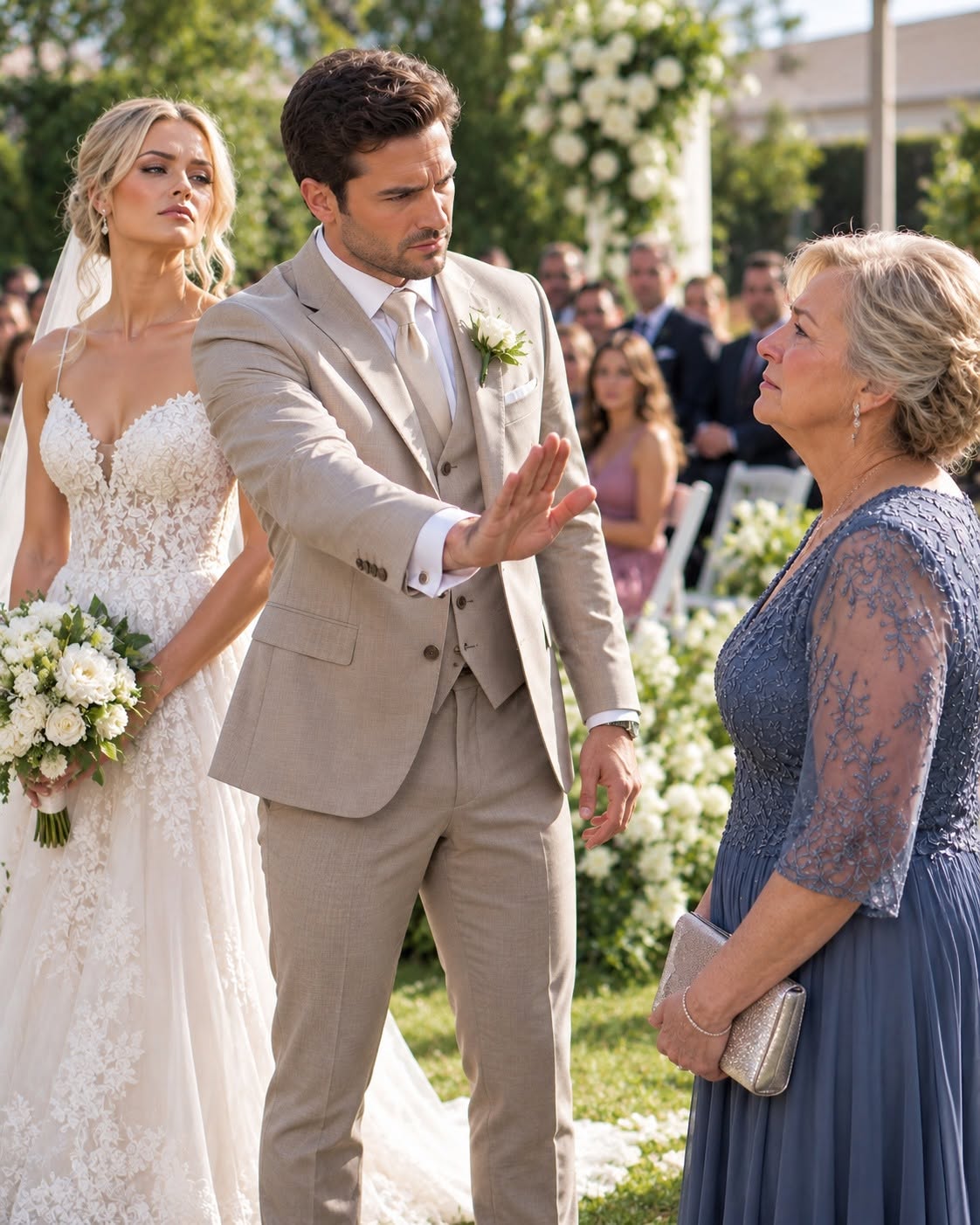
Michael suddenly stood.
“Stop.”
Everyone turned.
He was looking at Patricia.
“Just stop.”
For a moment, I thought he had finally found his courage.
Then his phone rang.
He glanced at the screen.
His face drained.
“It’s the venue.”
Vanessa snatched the phone from his hand.
“Hello?”
She listened.
“What do you mean, the payment guarantee has been removed?”
Another pause.
“No, you cannot release the date.”
Her voice rose.
“We have already invited two hundred people!”
I watched her grip tighten around the phone.
Then she looked directly at me.
And said something that changed everything.
“You can’t cancel it. Margaret Lewis is still responsible. We have her signature.”
I felt the room go cold.
Because I had never signed the revised guarantee Vanessa was talking about.
Daniel had warned me that morning about an additional document the venue had submitted.
A document bearing my name.
A document I had not authorized.
“Vanessa,” I said quietly, “what signature?”
She froze.
Michael looked at her.
“What is Mom talking about?”
Vanessa turned away.
“It’s just paperwork.”
“What paperwork?” he asked.
Patricia reached for her daughter’s arm.
“Vanessa, don’t say anything else.”
That was the moment I understood.
The wedding wasn’t simply more expensive than I had realized.
Someone had attempted to make me responsible for expenses I had never agreed to cover.
I reached for the envelope Daniel had helped me assemble electronically that afternoon.
Inside was a printed copy of the revised guarantee.
My name appeared at the bottom.
The signature looked remarkably like mine.
But it wasn’t.
My husband had taught me to sign my name with a distinctive loop in the letter L, a small habit I had maintained for forty-five years.
The signature on the guarantee had no loop.
I placed the document on the coffee table.
“Who signed this?”
Nobody answered.
Michael picked it up.
His eyes moved slowly across the page.
“Vanessa?”
She stared at the window.
“Michael, don’t start.”
“Did you sign my mother’s name?”
“It wasn’t supposed to matter.”
The words fell into the room like broken glass.
Patricia closed her eyes.
Emily covered her mouth.
Michael looked as though someone had struck him.
“What?”
Vanessa began speaking quickly.
“The coordinator needed the guarantee. Margaret was already paying. I knew she’d agree eventually. We were running out of time.”
“You forged my mother’s signature?”
“I was trying to save our wedding!”
Michael backed away.
One step.
Then another.
I watched my son stare at the woman he planned to marry.
And I saw something I hadn’t seen in months.
He was finally looking at her without trying to please her.
Patricia grabbed her handbag.
“This conversation is over.”
“No,” Michael said.
His voice shook.
“It isn’t.”
He turned toward me.
“Mom, did you know?”
“I learned about the document this afternoon. Daniel told me to speak to an attorney before making accusations.”
Vanessa looked frightened now.
Not embarrassed.
Not irritated.
Frightened.
“Margaret, please. We can fix this.”
I studied her face.
For months, I had tried to find the daughter-in-law I hoped she might become.
Someone I could share recipes with.
Someone who would sit at my kitchen table and tell me about her day.
But the woman standing before me had used my love for my son as a financial guarantee.
And when that wasn’t enough, she had put my name on a document without permission.
“I hope you do fix it,” I said. “But not by asking me to pretend it never happened.”
Michael sank onto the couch.
His hands covered his face.
Vanessa knelt beside him.
“Michael, baby, listen to me.”
He moved away from her touch.
“Don’t.”
She stared.
“I did this for us.”
“You lied to me.”
“I was protecting you from stress.”
“You told me my mother was threatening you.”
Vanessa said nothing.
Michael looked up.
“Was that true?”
Silence.
He swallowed.
“Did she ever say those things?”
Patricia spoke.
“Michael, relationships are complicated.”
He turned toward her.
“I’m asking Vanessa.”
Vanessa’s eyes filled.
“She made me feel judged.”
“How?”
“She asked questions about the budget.”
Michael stared at her.
“Because she was paying for it.”
Vanessa stood abruptly.
“You’re all acting like I’m some criminal!”
Nobody answered.
That silence frightened her more than an argument would have.
She grabbed her purse and walked toward the door.
Patricia followed.
Before leaving, Vanessa turned to Michael.
“If you love me, you’ll come with me.”
He looked at her for a long time.
Then he said, “I don’t know who you are right now.”
She waited.
He didn’t move.
The door slammed hard enough to rattle the picture frames.
For several seconds, the house was completely silent.
Then Michael began to cry.
Not the restrained tears of a man trying to preserve his dignity.
He folded forward, elbows on his knees, and sobbed into his hands.
Emily moved toward him.
I gently touched her arm.
“Let him.”
Michael needed to feel what he had done.
Not because I wanted him to suffer.
But because I had spent his entire life protecting him from pain, and somewhere along the way, he had begun to mistake protection for permission.
Eventually, he looked up.
“Mom.”
I waited.
“I’m sorry.”
His face was wet.
“I know that doesn’t fix anything.”
“No,” I said. “It doesn’t.”
He nodded.
“I believed her because it was easier.”
I sat across from him.
He continued.
“She kept saying you were controlling. That you wanted the wedding to be about you. And every time you asked about the money, I told myself she was right.”
He rubbed his eyes.
“I knew you were helping us. I knew how much you’d sacrificed. But I let her convince me that being grateful meant letting you interfere.”
I felt my throat tighten.
“Michael, asking whether you can afford something isn’t interference when I’m the one paying for it.”
“I know.”
“And when you sent that message, did you think about how I would feel?”
He looked down.
“Yes.”
That answer hurt more than if he’d said no.
“I knew it would hurt you,” he whispered. “I just thought you’d forgive me.”
I looked at the little boy in the photograph above the fireplace.
Then at the grown man before me.
“I probably will,” I said. “But forgiveness doesn’t mean we return to the way things were.”
He nodded slowly.
“I understand.”
“No, sweetheart. I don’t think you do yet.”
I leaned forward.
“I love you. I will always love you. But I cannot keep paying for your choices, financially or emotionally. You are old enough to stand beside the people you love without requiring someone else to disappear.”
He covered his face again.
This time, I let the silence remain.
That evening, Emily stayed to make dinner.
Michael left just before sunset.
He asked if he could hug me.
I said yes.
He held me tightly.
For a moment, I remembered the weight of his little arms around my neck when he was four years old.
Then he stepped away.
“Can I call you tomorrow?”
“You can.”
“Will you answer?”
I considered the question.
“If you’re calling to talk to your mother, yes.”
He nodded.
“And if you’re calling to ask me to fix the wedding, no.”
His mouth trembled.
“Okay.”
After he left, Emily stood beside me at the front window.
We watched his car disappear down the street.
“Do you think he’ll be all right?” she asked.
I touched the glass.
“I think he’ll have to learn how.”
The next morning, I met with an attorney named Susan Parker.
She was a practical woman with silver-framed glasses and a desk so orderly that I immediately trusted her.
She reviewed the contracts and the disputed guarantee.
Then she looked at me.
“Mrs. Lewis, you did the right thing by preserving these documents.”
“What happens now?”
“We’ll notify the venue that you dispute the signature and request their records. We can also discuss reporting the suspected forgery. But I want you to understand something.”
I waited.
“You are not obligated to rescue the people who created this situation.”
I had spent so many years being needed that the sentence felt almost foreign.
I repeated it silently on the drive home.
I am not obligated to rescue them.
Over the following weeks, the truth emerged piece by piece.
The venue provided its records.
The disputed document had been submitted from Vanessa’s email account.
Messages showed that she had repeatedly assured the coordinator I had approved the additional guarantee.
When confronted through her attorney, Vanessa admitted she had signed my name without permission.
The matter became a legal dispute rather than the quiet misunderstanding she had hoped it would remain.
The venue agreed not to pursue me under the disputed guarantee while the matter was resolved. The payments I had properly authorized remained subject to their original terms.
I did not recover every dollar.
Some deposits were nonrefundable.
Some expenses had already been incurred.
But I stopped the financial bleeding.
And for the first time in years, I refused to feel guilty for doing so.
Michael canceled the wedding.
Not postponed.
Canceled.
Vanessa initially told friends that I had destroyed their relationship over money.
But the story became harder to maintain when Michael refused to repeat it.
He told the people who asked that he had failed to protect his mother and that Vanessa had submitted a document without her permission.
He didn’t make excuses.
He didn’t ask anyone to choose sides.
And when Vanessa demanded that he publicly defend her, he declined.
Their engagement ended three weeks later.
The disputed guarantee was ultimately withdrawn as part of a written settlement in which Vanessa accepted responsibility for the unauthorized submission and agreed to cover the resulting documented costs under a payment arrangement.
Susan explained that the settlement didn’t erase what had happened.
But it meant my name was no longer attached to a financial promise I had never made.
I signed the final paperwork with my own pen.
The one Thomas had given me for our twentieth anniversary.
That small act felt like taking back something larger than money.
For a while, Michael and I barely spoke.
He called every Sunday.
Sometimes I answered.
Sometimes I didn’t.
When I did, our conversations were awkward.
He asked about the weather.
I asked about work.
Neither of us knew how to cross the distance between us.
One Sunday, he called while I was baking apple pie.
“Mom, can I come over?”
I hesitated.
“What for?”
“To fix the back porch step.”
I looked through the kitchen window.
The wooden step had been loose for nearly two years.
I’d mentioned it to him several times.
He had always promised to get around to it.
“All right,” I said.
He arrived carrying a toolbox.
No flowers.
No elaborate apology.
Just a toolbox and a pair of work gloves.
He spent three hours replacing the damaged wood.
I watched through the window as he measured twice, cut once, and carefully sanded the edges.
When he finished, he came inside.
“It’s safe now.”
“Thank you.”
He looked around the kitchen.
“Anything else need fixing?”
I thought about the years between us.
The missed birthdays.
The dinners he’d canceled.
The moments when I had made excuses for him because admitting the truth felt unbearable.
“Yes,” I said softly. “But not with a hammer.”
He lowered his eyes.
“I know.”
I poured two cups of coffee.
We sat at the Formica table.
And for the first time, my son listened without defending himself.
I told him about the nights I had worked until my feet bled.
About the fear I felt after his father died.
About sitting alone at his college graduation because the second ticket had gone to a girlfriend he barely remembered now.
About how proud I had been of him.
And how deeply it had hurt to discover that he was ashamed of me.
He didn’t interrupt.
When I finished, he stared at his coffee.
“Mom, I wasn’t ashamed of you.”
I looked at him.
“Then why didn’t you want me there?”
He took a long breath.
“Because Vanessa made everything about appearances, and I started believing that appearances mattered more than people.”
His voice broke.
“And because I was a coward.”
I reached across the table.
Not to excuse him.
Not to make the pain disappear.
Just to let him know that truth, however late, still mattered.
He took my hand.
“I’ve started seeing a counselor,” he said.
That surprised me.
“Have you?”
He nodded.
“I need to understand why I let someone else decide how I treated my own family.”
I squeezed his fingers.
“That’s a good place to start.”
Spring arrived slowly that year.
The maple tree outside my kitchen window grew new leaves.
Emily’s children started spending Friday evenings at my house again.
My grandson, Noah, helped me plant tomatoes.
My granddaughter, Sophie, insisted we put sunflowers along the fence because, according to her, every grandmother deserved flowers taller than herself.
Michael began coming over on Saturdays.
At first, he repaired things.
A dripping faucet.
A loose cabinet hinge.
The porch railing.
Then, when there was nothing left to fix, he kept coming.
Sometimes he brought groceries.
Sometimes he helped Emily’s children with homework.
Sometimes we sat in the backyard without saying much at all.
I discovered that rebuilding trust was less like repairing a broken plate and more like tending a neglected garden.
You couldn’t force it to grow.
You could only show up, pull the weeds, and keep watering.
One afternoon, nearly six months after the wedding was canceled, Michael arrived carrying a small cardboard box.
“I found something,” he said.
He set it on the kitchen table.
Inside were old photographs, school papers, and a folded letter.
The letter was addressed to me.
In Thomas’s handwriting.
My heart stopped for a moment.
“Where did you get this?”
“Dad left it in a box of my college things. I never opened it. I thought it was just old paperwork.”
My hands trembled as I unfolded the page.
Thomas had written it shortly before he died.
His handwriting was uneven, but unmistakable.
My dearest Margaret,
If you’re reading this, then I’m probably not there to tell you what I should have said more often.
You have spent your life making sure everyone else has enough.
Enough food.
Enough warmth.
Enough money.
Enough love.
But I’ve watched you give away pieces of yourself until there’s hardly anything left for you.
Promise me something.
When the children are grown, don’t spend the rest of your life proving how much you love them.
They already know.
Or they should.
Take the trip we always talked about.
Buy the flowers you think are too expensive.
Sit in the sunshine without feeling guilty.
And if anyone ever makes you feel small, remember that I spent thirty-four years beside you and never once met a woman bigger in spirit.
You are not difficult to love, Margaret.
You are simply worth loving properly.
Always yours,
Thomas.
I couldn’t finish reading aloud.
The words blurred.
Michael moved beside me.
“Mom?”
I pressed the letter against my chest.
For years, I had believed my husband left me only memories and responsibilities.
But here he was, reaching across time to remind me that my life belonged to me, too.
Michael put his arm around my shoulders.
“I wish Dad could see me now,” he whispered.
I looked at him.
“He’d be disappointed in some of your choices.”
Michael nodded.
“I know.”
“But he’d be proud that you’re trying to become better.”
My son began crying.
I held him.
And this time, the embrace didn’t feel like an attempt to erase what had happened.
It felt like two people finally accepting the truth and choosing to keep loving each other anyway.
A week later, I did something I had never done before.
I booked a trip.
Not a bus tour.
Not a weekend at a nearby hotel.
A real vacation.
Thomas and I had always dreamed of seeing the coast of Maine in autumn.
We used to talk about little fishing villages, white lighthouses, and the sound of waves against rocky shores.
Every year, something came up.
School expenses.
Car repairs.
Medical bills.
Then Thomas got sick.
And the dream went into the drawer with the other things we meant to do someday.
I booked a small seaside cottage for ten days in October.
When I told Emily, she clapped her hands.
“Mom, finally!”
When I told Michael, he smiled.
“Dad would love that.”
“I know.”
Then he hesitated.
“Would you like me to drive you to the airport?”
I looked at him.
“I would.”
October arrived with crisp mornings and golden leaves.
On the day of my flight, Michael came at six in the morning.
He carried my suitcase to the car.
Emily and the children were waiting on the porch.
Sophie hugged me so tightly that I nearly lost my balance.
“Bring me a seashell, Grandma.”
“I’ll find the prettiest one.”
Noah handed me a small notebook.
“For writing down your adventures.”
I kissed his forehead.
At the airport, Michael walked me to security.
He seemed nervous.
“Mom, there’s something I want to say.”
I waited.
“I used to think being a good son meant becoming successful enough that you wouldn’t have to worry about me.”
He looked down at his shoes.
“But I forgot that being a good son also means making sure you never have to wonder whether you’re wanted.”
My throat tightened.
He continued.
“I can’t change what I did. But I want to spend the rest of my life making sure you know you belong wherever I am.”
I touched his cheek.
“Michael, you don’t have to spend your life repaying me.”
“I know.”
“Just live it with decency.”
He nodded.
“And remember that love is not something you prove with money.”
He hugged me.
Then he stepped back and let me go.
That mattered more than he knew.
Because for the first time, I was leaving not to escape pain or fulfill an obligation.
I was leaving because I wanted to see the ocean.
The cottage in Maine was small and white, with blue shutters and a narrow porch overlooking the water.
The first evening, I sat outside wrapped in a wool blanket.
The sky turned pink, then lavender.
Fishing boats moved slowly toward the harbor.
Somewhere in the distance, a bell rang.
I held Thomas’s letter in my lap.
For a long time, I watched the waves.
Then I whispered, “We made it, darling.”
A breeze moved across the porch.
I smiled through my tears.
The following morning, I walked to the lighthouse.
The path was uneven, and I took my time.
At the edge of the rocks, I found a smooth white stone.
I picked it up and turned it over in my palm.
Thomas had always collected stones from places we visited.
He said they were better than souvenirs because the earth had made them slowly, without trying to impress anyone.
I put the stone in my pocket.
For ten days, I ate fresh blueberry muffins, wandered through bookstores, watched the tide come in, and slept with the windows cracked so I could hear the ocean.
I bought myself a blue sweater.
An unnecessarily expensive one.
I didn’t apologize to anyone.
On my last evening, I called Michael.
He answered immediately.
“Hey, Mom.”
“Hello, sweetheart.”
“How’s paradise?”
“Cold,” I said. “And beautiful.”
He laughed.
We talked about ordinary things.
The weather.
Emily’s children.
The tomatoes that had finally stopped producing.
Then he said, “Mom, I found something else in Dad’s box.”
My heart fluttered.
“What?”
“A photograph. From your wedding.”
I smiled.
“Oh, I’ve seen hundreds.”
“Not this one.”
He paused.
“It’s you and Dad standing outside the church. You’re laughing so hard you’re leaning against him. On the back, Dad wrote something.”
I waited.
Michael’s voice softened.
“He wrote, ‘The best day of my life wasn’t when she said yes. It was the day I realized she would never have to pretend to be someone else with me.’”
I closed my eyes.
The ocean moved steadily beyond the porch.
For months, I had thought my story was about being excluded from a wedding.
About money.
About betrayal.
About twenty-two missed calls.
But sitting there with the Atlantic stretching into the darkness, I finally understood something.
The most important thing I had done that Tuesday afternoon wasn’t stopping the payments.
It wasn’t removing Michael from an account.
It wasn’t confronting Vanessa.
It was choosing not to abandon myself just because someone I loved had decided I was inconvenient.
Thomas had understood that long before I did.
And perhaps that was the final gift he had left me.
Permission.
Permission to be loved without earning it.
Permission to say no.
Permission to let grown children make their own mistakes.
Permission to have a life that wasn’t built entirely around being needed.
When I returned to Columbus, the leaves had begun falling across my front lawn.
Michael was waiting at the airport.
He took my suitcase and smiled.
“Welcome home, Mom.”
On the drive back, he told me about his work and a cooking class he’d started taking.
He’d burned his first attempt at lasagna.
I laughed so hard I had to wipe my eyes.
When we reached my house, Emily’s car was already in the driveway.
Inside, the kitchen smelled of roast chicken.
My grandchildren had decorated the table with paper leaves and little candles.
Sophie ran toward me.
“Grandma! Did you bring the seashell?”
I reached into my bag.
“Of course.”
She held it against her ear.
“I can hear the ocean!”
Noah showed me the pages he’d saved in his notebook for my adventures.
Emily hugged me.
Michael carried my luggage upstairs.
And for a moment, standing in that warm kitchen, I felt the shape of my life changing.
Not into something perfect.
But into something honest.
We ate together that evening.
There were mismatched plates, spilled gravy, and a heated argument about whether apple pie should be served with ice cream or cheddar cheese.
Michael washed the dishes.
Emily dried them.
The children played cards at the table.
And I sat in my favorite chair, listening.
Nobody asked me to be quieter.
Nobody worried whether the house looked elegant enough.
Nobody treated my laughter as an embarrassment.
Later, when everyone had gone home, I returned to the kitchen sink.
The old “Best Mom” mug was sitting beside the faucet.
Its faded letters were almost invisible now.
I picked it up carefully.
For a long time, that mug had reminded me of the little boy who once thought I could do anything.
Then, after his message, it had reminded me of everything I’d lost.
But that night, I saw something different.
A crooked little cup made by a child who had loved me before he understood anything about money, appearances, or social standing.
The love had been real.
So had the betrayal.
And now, slowly, something new was growing between those two truths.
I washed the mug and placed it on the shelf.
Then I opened the drawer.
The manila envelope was still there.
But I no longer needed to keep Thomas’s letter hidden among old documents.
I took it out and placed it in a small frame beside our wedding photograph.
Underneath, I put the smooth white stone from Maine.
I stood back and looked at them.
The young woman laughing outside the church.
The husband who had loved her without conditions.
The little stone from a journey she had finally taken.
And the words that had waited years to find her.
You are simply worth loving properly.
Outside, the neighborhood settled into its familiar nighttime sounds.
A car passed.
A porch light clicked off.
Somewhere, a dog barked.
I turned out the kitchen light and walked toward my bedroom.
Halfway down the hall, my phone buzzed.
A message from Michael.
Love you, Mom. Thank you for dinner. See you Saturday.
I smiled.
Then I typed back.
Love you too, sweetheart. Drive safely.
No pleading.
No guilt.
No fear.
Just love.
The kind that had finally learned how to stand on its own feet.
And if you’re wondering what happened to those twenty-two missed calls, I never deleted them.
Not because I wanted to punish my son.
Not because I needed a reminder of Vanessa.
But because they marked the afternoon I stopped confusing sacrifice with love.
For sixty-eight years, I had believed being a good mother meant making sure everyone else had a place at the table, even if I had to give up my own chair.
Now I knew better.
A loving family doesn’t require one person to disappear so everyone else can feel comfortable.
And a mother’s worth isn’t measured by how much she pays, how much she forgives, or how quietly she accepts being hurt.
Sometimes the strongest thing a woman can do is answer cruelty with calm, close her checkbook, open her front door to the truth, and trust that the people who genuinely love her will find their way back.
That night, I slept with my window slightly open.
A cool Ohio breeze stirred the curtains.
On the bedside table stood the photograph of Thomas and me on our wedding day.
I touched the frame once before turning off the lamp.
“Goodnight, darling,” I whispered.
And in the quiet, I imagined him smiling.
Because I hadn’t ruined my son’s wedding.
I had finally saved something that mattered more.
The woman his father had loved.
The mother his children still needed.
And the life that, at sixty-eight years old, was still beautifully, wonderfully mine.